
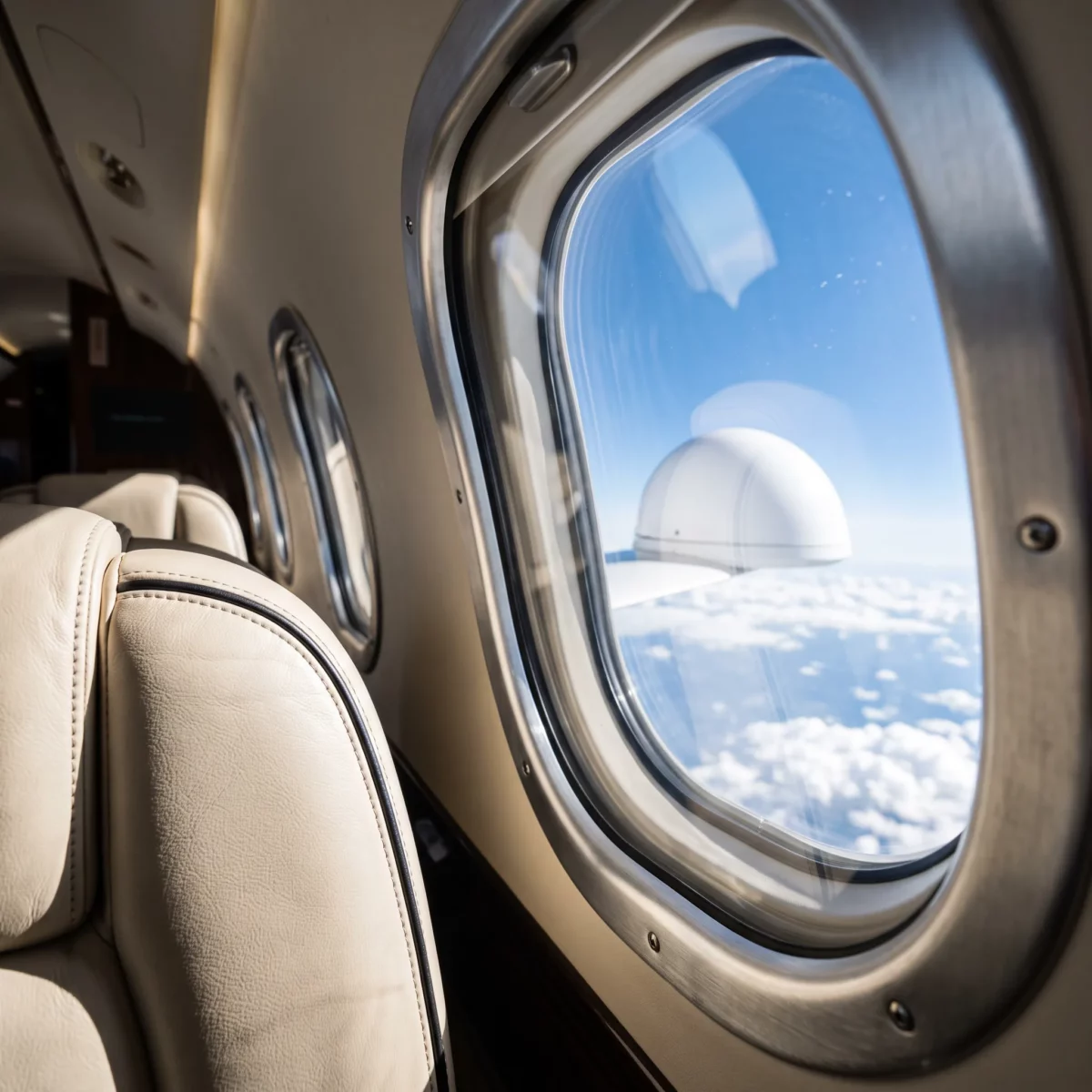
You’re three hours into a transatlantic leg, trying to close a deal over video call, and the connection drops. Again. Before you blame the crew or the cabin systems, know this: the real answer lives in orbit, thousands of miles above your Gulfstream or Global 7500. It comes down to which satellite band your aircraft’s antenna talks to.
Most owners never think about this until connectivity fails them mid-flight. But understanding Ka-band versus Ku-band versus Air-to-Ground systems changes how you evaluate an aircraft purchase, a charter operator, or even which routes you should avoid flying without backup connectivity.

Two Satellite Bands, Two Different Philosophies
Both Ka-band and Ku-band systems bounce your data off satellites in geostationary orbit, roughly 22,000 miles above the equator. The difference is frequency and, more importantly, how the satellite operators built their networks around that frequency.
Ku-band came first. It’s been flying on business jets since the early 2010s, and it uses wider, less focused satellite beams. Think of it as older infrastructure that’s been proven over a decade of real-world use. Coverage is broad but bandwidth per aircraft is limited because you’re sharing capacity across a wide footprint.
Ka-band is the newer approach. It uses narrower, high-throughput spot beams, similar in concept to how 5G cell towers focus signal rather than blanket an area. This delivers dramatically faster speeds, but it depends on dense satellite constellations to maintain coverage as your aircraft moves between spot beams.
Where Air-to-Ground Fits In
ATG systems skip satellites entirely. Your aircraft connects to cell towers on the ground, similar to how your phone works, just pointed skyward instead of at a person walking down the street. Gogo built its business jet reputation on this technology domestically.
- Ku-band: Reliable global coverage, moderate speeds, mature technology with over a decade of operational history
- Ka-band: Higher peak speeds, lower latency, but coverage gaps exist over polar regions and remote oceanic routes
- Air-to-Ground: Fast and affordable over the continental United States, but useless the moment you cross open water
What This Means at 45,000 Feet
Here’s the practical reality. If you fly mostly domestic legs, ATG paired with a Ku-band backup gives you strong performance without paying for capability you won’t use. If you’re regularly crossing the Atlantic or Pacific, Ka-band’s higher throughput matters, but only if your route stays within the constellation’s dense coverage zones.
Polar routes, common on Asia-to-North America legs, remain a weak spot for pure Ka-band systems. Some operators solve this with dual-band antennas that automatically switch between Ka and Ku depending on location, giving you the speed advantage where available and a fallback where it isn’t.
Latency Matters More Than You Think
Speed gets all the attention, but latency, the delay between sending and receiving data, determines whether your video call feels natural or frustrating. Geostationary satellites sit so far from Earth that round-trip latency typically runs 500 to 600 milliseconds, regardless of band. That’s why even a fast Ka-band connection can still feel slightly laggy on a live call.
This is where newer low-Earth-orbit constellations, like Starlink’s aviation division, change the equation. Operating at roughly 340 miles altitude instead of 22,000, LEO satellites cut latency to under 50 milliseconds in many cases. Several fractional operators have already begun retrofitting fleets with LEO terminals, and the difference is noticeable the moment you join a video call.

Comparing the Systems Side by Side
| System | Typical Speed | Best Use Case |
|---|---|---|
| Ku-band satellite | 10-20 Mbps | Global routes, proven reliability |
| Ka-band satellite | 30-100 Mbps | High-bandwidth transatlantic and transpacific legs |
| Air-to-Ground | Up to 15 Mbps | Domestic U.S. flying only |
| LEO constellation | 100-200+ Mbps | Video conferencing, streaming, low-latency needs |
These figures represent typical real-world performance, not marketing peak numbers. Actual speeds still depend on how many passengers are streaming simultaneously and how far you are from a satellite’s beam center.
What to Ask Before You Buy or Charter
If connectivity matters to how you use your aircraft, whether for closing deals or keeping the kids entertained on long legs, ask specific questions before signing anything.
- Which band or bands does the installed antenna support, and is it a dual-band system?
- Does coverage include the specific routes you fly most often, including polar paths if relevant?
- What’s the actual data allowance, and are there overage charges for heavy streaming?
- Has the operator announced plans to retrofit with LEO technology, and on what timeline?
Charter brokers and fractional providers increasingly list connectivity specs alongside cabin dimensions and range figures. That’s a sign of how much this has shifted from a nice-to-have to a deciding factor in aircraft selection.

The Road Ahead
Connectivity in business aviation is moving fast, arguably faster than any other cabin technology right now. LEO constellations are reshaping expectations, and within a few years, ground-based latency comparisons to in-flight Wi-Fi won’t sound absurd anymore. For now, understanding what band powers your connection, and what it can’t do, keeps you from being surprised the next time a video call freezes over the middle of the Atlantic.