
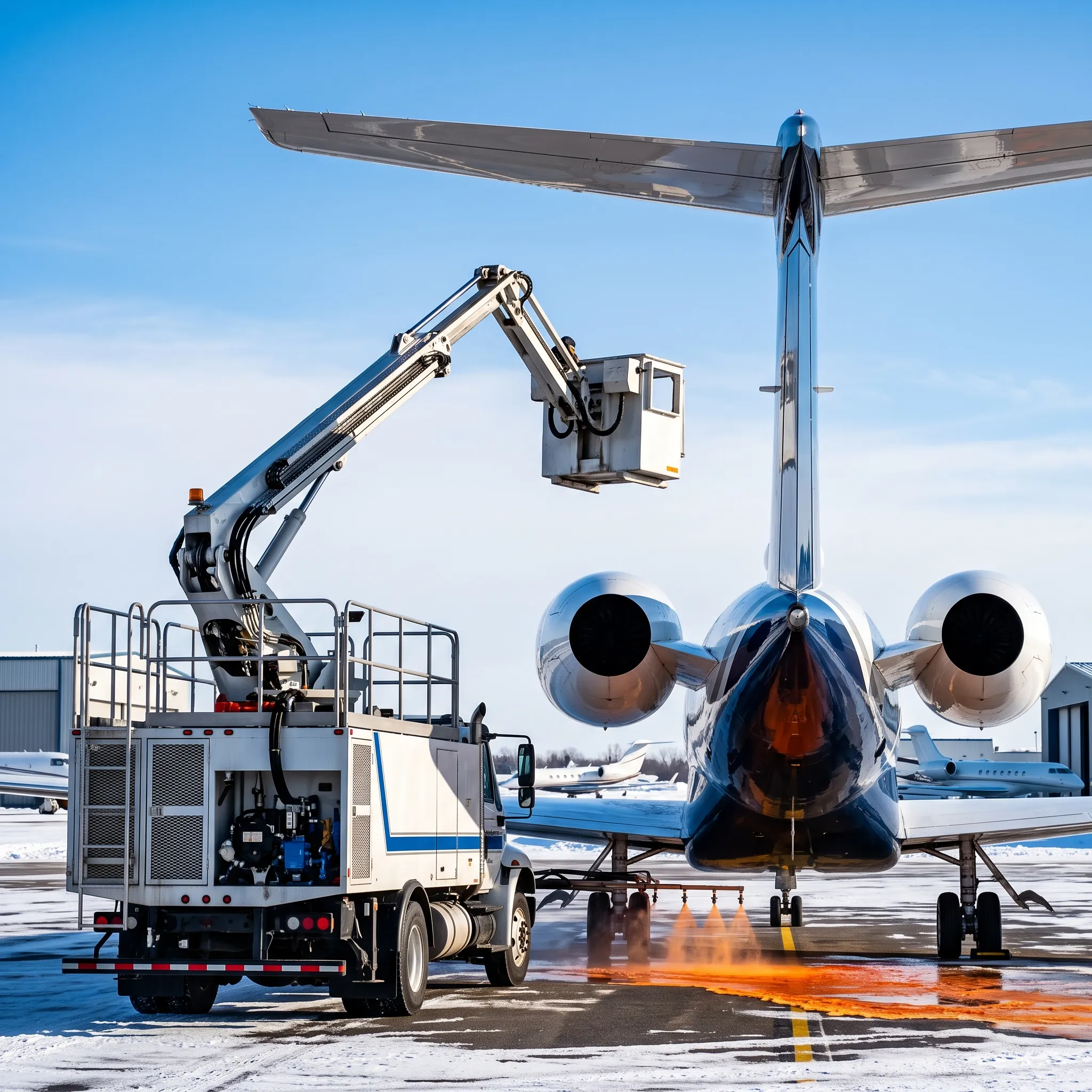
You’re sitting in the cabin of a Gulfstream G450, watching a crew in orange coveralls spray your aircraft with what looks like hot orange syrup. An hour later, you get a supplemental invoice for $3,800. No explanation. Just a line item that says de-icing services. If you’ve ever flown privately in winter, this scene is probably familiar. Understanding what actually happened on that ramp, and why it costs what it costs, makes that invoice a lot easier to swallow.
De-Icing vs. Anti-Icing: Two Different Jobs
These terms get used interchangeably, but they describe two distinct processes. De-icing removes contamination that’s already on the aircraft. Ice, snow, frost. It cleans the surfaces. Anti-icing then applies a protective coating that slows new contamination from forming while the aircraft taxis to the runway.
Both matter enormously. A thin layer of frost on a wing, even something that looks minor, disrupts the airflow that generates lift. The FAA’s clean aircraft concept requires that no frozen contamination exist on critical surfaces at the moment of takeoff. No exceptions. So when your crew calls for de-icing, it’s not a suggestion based on preference. It’s a regulatory requirement backed by physics.
What Type I Fluid Actually Does
Type I fluid is the workhorse of ground de-icing. It’s a heated mixture of propylene glycol and water, sprayed hot at temperatures between 140 and 180 degrees Fahrenheit. That heat does most of the work, melting ice and snow on contact. The glycol lowers the freezing point of the water so it runs off the aircraft rather than refreezing immediately.
Type I is thin. Low viscosity by design. It flows off the wings quickly, which is exactly what you want during the de-icing phase. The problem is that it also dissipates quickly, leaving surfaces vulnerable again almost immediately. If there’s active precipitation or you’re sitting in a long taxi queue, Type I alone isn’t enough.
Why Type IV Commands a Premium
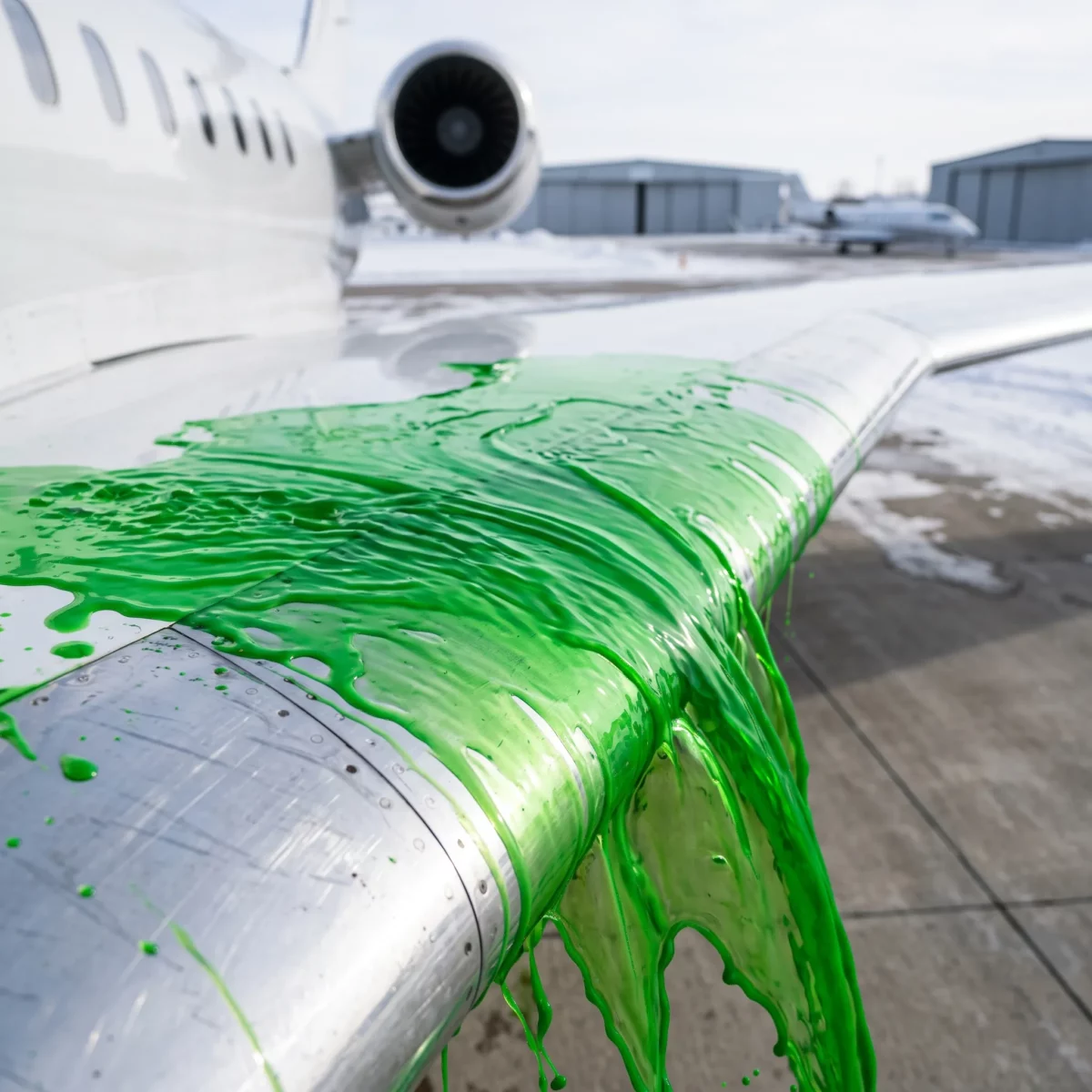
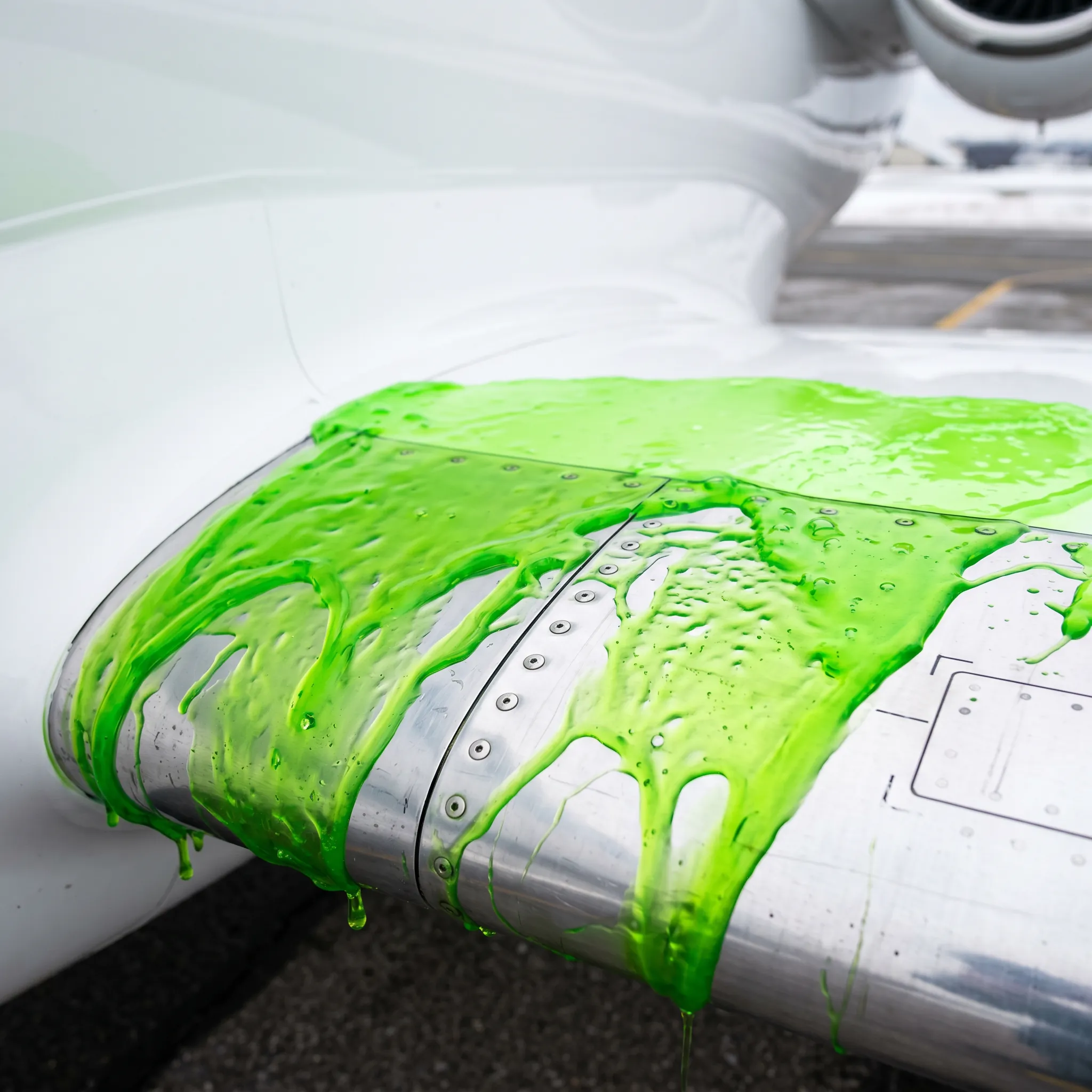
Type IV fluid is a different animal entirely. It’s considerably thicker, engineered to cling to aircraft surfaces and form a protective gel layer that resists new ice accumulation. The color differs too: Type I runs orange or yellow, while Type IV appears bright green. Ground crews use this visual distinction to quickly identify which fluid has been applied and estimate how much protective time remains.
The cost difference is significant. Type IV fluid can run three to five times the price of Type I per gallon. On a large-cabin jet like a Bombardier Global 6500 or a Dassault Falcon 8X, a full anti-icing treatment might consume 80 to 120 gallons. Do that math and the invoice starts making sense.
Holdover Time: The Clock That Matters Most
Once Type IV goes on the aircraft, a clock starts. That window of protection is called holdover time, and it’s the most operationally critical concept in winter ground operations.
Holdover time isn’t a fixed number. It varies based on outside air temperature, precipitation type, precipitation intensity, and wind. The FAA publishes holdover time guidelines that ground crews and pilots reference in real time. Light freezing drizzle at 28 degrees Fahrenheit might give you 45 minutes of protection. Heavy snow at 26 degrees might shrink that window to under 15 minutes.
When a crew requests a second de-icing treatment because of a lengthy taxi delay, that’s not an upsell. The first application’s holdover time expired before the aircraft reached the runway. The aircraft needs to be clean again before rotation. Skipping that second treatment to save money is not an option any reputable operator will take.
A Quick Comparison of the Two Fluid Types
| Characteristic | Type I | Type IV |
|---|---|---|
| Primary purpose | Remove existing ice and snow | Prevent new ice accumulation |
| Viscosity | Low, flows off quickly | High, clings to surfaces |
| Application temperature | Heated, 140-180°F | Unheated or slightly heated |
| Typical holdover time | Under 10 minutes | Up to 45-80 minutes |
| Relative cost per gallon | Baseline | 3-5x Type I |
| Color | Orange or yellow | Bright green |
What Owners and Charter Clients Should Expect
De-icing costs are almost always a pass-through expense in charter contracts and aircraft management agreements. They sit outside the base hourly rate because they’re unpredictable by nature. A flight departing Denver in January might need a full two-step treatment. The same routing in October needs nothing.
A few things worth knowing before winter flying season arrives:
- Ask upfront: Your charter operator should be able to estimate de-icing costs based on your departure airport and forecast conditions. Get a range before you fly, not after.
- Understand the sequence: A proper treatment applies Type I first to clean, then Type IV to protect. Operators who skip straight to Type IV on a contaminated aircraft are cutting corners.
- Budget for repetition: A long taxi in active snowfall can mean two or even three treatments at busy airports. Build that into your winter travel budget.
- FBO selection matters: Premium fixed-base operators at major airports maintain de-icing trucks on standby during winter. Smaller FBOs may have limited equipment, adding delay and risk.
- Holdover time drives timing: Your crew will coordinate with the tower to minimize the gap between de-icing and takeoff. When ATC extends that window unexpectedly, retreatment is the only safe response.
The Safety Math Is Simple
Private aviation has an exceptional safety record partly because operators don’t compromise on ground servicing the way cost-pressured commercial carriers sometimes do. A $4,000 de-icing bill on a $30,000 charter flight is a rounding error against the value of what’s being protected. The aircraft, the passengers, and the crew.
Winter flying in private aviation remains one of the safest and most reliable ways to travel when conditions ground commercial traffic. That reliability comes directly from the standards applied on the ramp before the wheels leave the ground. Knowing what goes into that process makes it easier to appreciate rather than question the line items when the invoice arrives.