

Most private jet clients never think about what’s hanging off the wings. That’s understandable. You’re focused on the cabin, the routing, the timing. But the engine type powering your aircraft shapes nearly every meaningful aspect of your trip: how fast you get there, how much runway the aircraft needs, and yes, what it costs per hour. Understanding the difference between a turbojet, a turbofan, and a turboprop isn’t an engineering exercise. It’s the kind of knowledge that makes you a smarter buyer and a more confident flyer.

The Turbojet: The Original Jet Engine
The turbojet is the purest form of jet propulsion. Air enters the front, gets compressed, mixes with fuel, ignites, and blasts out the back as a high-velocity exhaust stream. That exhaust is what moves the aircraft forward. Simple in concept, but brutally inefficient at lower altitudes and speeds.
Turbojets dominated early military and commercial aviation in the 1950s and 1960s. In private aviation today, you won’t find them on new production aircraft. They’ve been largely replaced by turbofans, which deliver far better fuel economy. That said, understanding the turbojet matters because the turbofan is essentially a turbojet with a significant modification bolted onto the front.
The Turbofan: The Engine Behind Almost Every Business Jet
Walk up to a Gulfstream G700, a Bombardier Global 7500, or a Dassault Falcon 10X, and what you’re looking at are turbofan engines. The difference from a turbojet? A large fan at the front that pushes a significant volume of air around the core engine, not through it. That bypass air contributes to thrust without burning any fuel. The ratio of bypassed air to core airflow is called the bypass ratio, and it’s one of the most important numbers in modern engine design.
Higher bypass ratios mean better fuel efficiency and a noticeably quieter cabin. The Rolls-Royce Pearl 10X engines on the Falcon 10X and the GE Passport engines on the Global 7500 both use high-bypass architecture. That’s part of why ultra-long-range jets can now connect New York to Tokyo nonstop while burning meaningfully less fuel per passenger mile than aircraft from two generations ago.
For transcontinental and international routing, turbofan-powered jets are the clear choice. They cruise efficiently at altitudes between 41,000 and 51,000 feet, well above commercial traffic, and reach speeds approaching Mach 0.90 or higher on modern platforms. When a charter operator quotes you an hourly rate on a large-cabin or ultra-long-range jet, a significant portion of that cost reflects the fuel burn of those turbofan engines.
The Turboprop: Misunderstood and Underestimated
The turboprop uses the same basic gas turbine core as a jet engine, but instead of directing all that energy into thrust, it uses most of it to spin a propeller. This distinction matters enormously for how and where these aircraft operate.
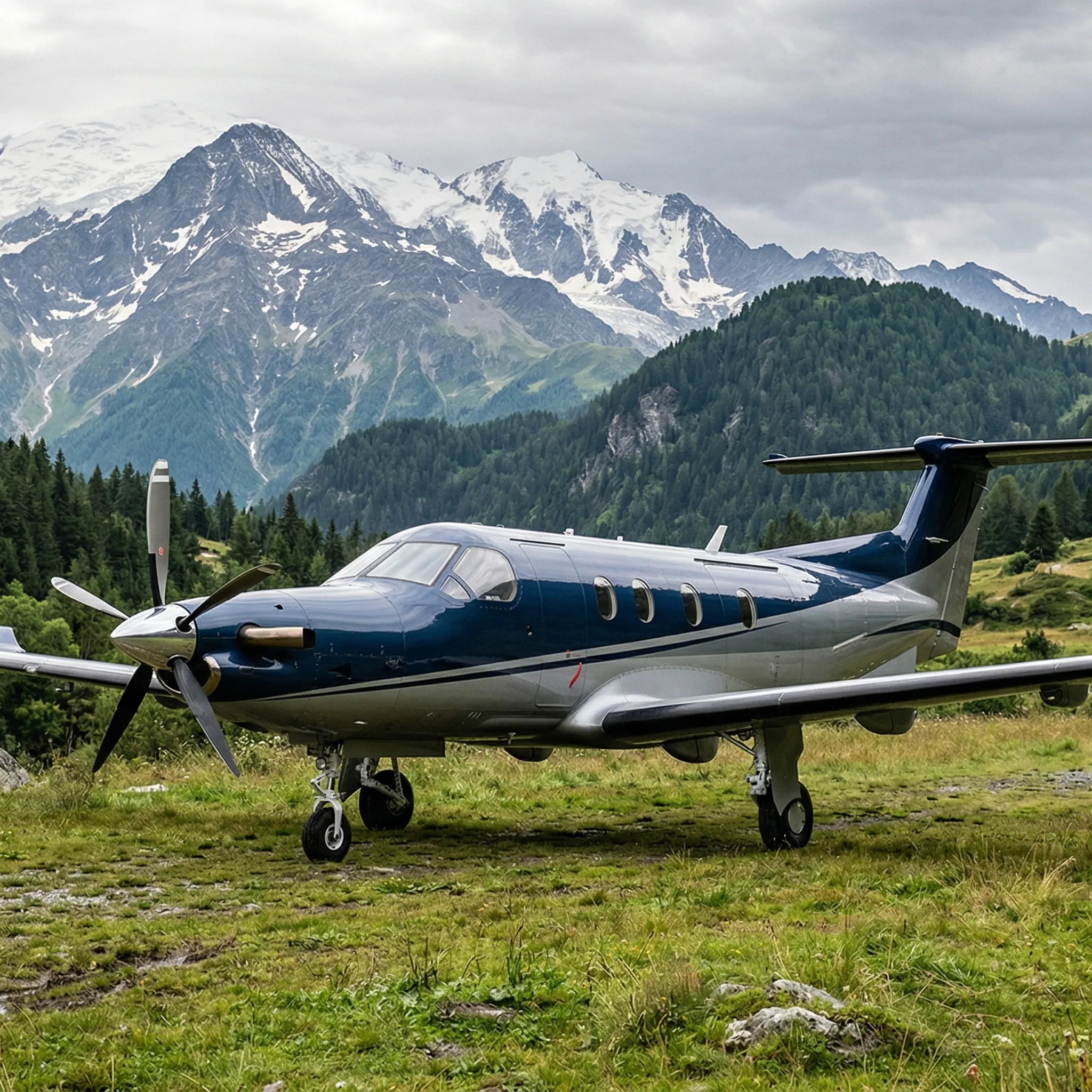
Turboprops like the Pilatus PC-12 or the Daher TBM 960 cruise at lower altitudes, typically between 20,000 and 30,000 feet, and at speeds around 300 knots. Slower than a light jet, yes. But the trade-off is access. A turboprop can operate from unpaved strips and short runways that would be impossible for most jets. A PC-12 needs roughly 2,500 feet of runway to take off at full load. Many light jets require double that.
For reaching remote properties, island destinations, or rural airstrips with no instrument approaches, a turboprop is often the only viable option. Medical transport operators, bush pilots, and owners of ranches or island estates rely on them precisely for this reason. They’re also considerably less expensive to operate, which keeps charter costs lower on short regional hops where a jet’s speed advantage barely has time to accumulate.
How Engine Type Shapes Charter Pricing and Airport Access
This is where the engineering gets personal. Charter operators price their aircraft based on operating costs, and engine type is a primary driver. A light turbofan jet like the Embraer Phenom 300E might run $4,500 to $5,500 per hour on charter. A mid-size like the Cessna Citation Longitude could run $6,500 to $8,000 per hour. Ultra-long-range turbofan jets can exceed $15,000 per hour. Turboprops generally land well below these figures.
Runway requirements tell a similar story. Turbofan jets are engineered for performance airports: long, paved runways with instrument approaches. Turboprops thrive where jets can’t go. If your destination is a small Caribbean island, a mountain resort airstrip, or a bush strip in remote Alaska, understanding this distinction isn’t academic. It determines whether you can get there at all.
Matching the Engine to the Mission
- Short regional hops under 500 miles: A turboprop often makes more practical sense than a light jet. Less cost, and the speed advantage of a jet barely registers on short legs.
- Domestic city pairs, 500 to 2,500 miles: Light to mid-size turbofan jets hit the sweet spot here. Fast enough to justify the cost, efficient enough to keep hourly rates competitive.
- Transcontinental and international routes: Large-cabin and ultra-long-range turbofan jets are the right tool. The fuel burn looks significant on paper, but spread across a 6,000-plus nautical mile range with a full cabin, the economics work.
- Remote or short-strip destinations: Turboprops remain unmatched. The operational flexibility they offer is something no turbofan jet can replicate.
Why This Matters When You Book
When a charter broker presents you with aircraft options, you’re often looking at the same cabin category but different engine types under the hood. Knowing what drives the price difference, and what operational capabilities each engine enables, puts you in a much stronger position to choose the right aircraft for your specific mission.
A turbofan-powered light jet between two major airports on a calm day is a different proposition than a turboprop into a short strip with crosswinds. Both might be called “private aviation.” But the engineering behind each one shapes your entire experience from wheels-up to touchdown. The clients who understand this tend to book smarter, fly more efficiently, and rarely find themselves surprised by what an aircraft can or can’t do.