
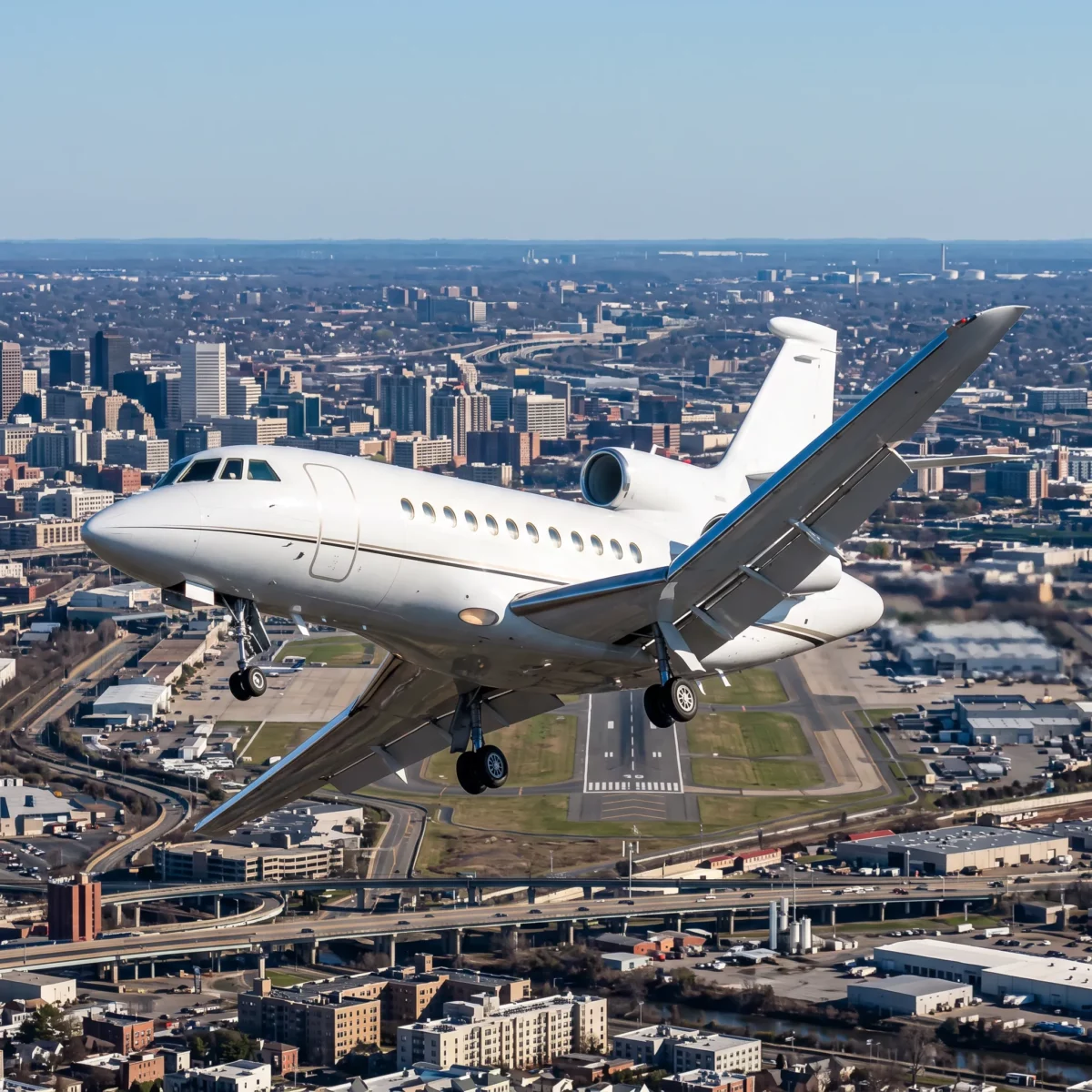
Ask most owners why their jet can’t land at London City Airport and they’ll guess it’s about runway length. It isn’t. London City’s runway measures a perfectly workable 1,508 meters. The real barrier sits in the sky above it: a descent angle so steep that most business jets simply aren’t built to fly it, let alone land on it safely.
This is the world of steep approach certification, a narrow but consequential corner of aviation engineering that quietly determines which private jets can reach some of Europe’s most desirable, most congested destinations.
Why 3 Degrees Doesn’t Work Everywhere
Almost every commercial and private aircraft in the world is designed around a standard 3-degree glide path. It’s gentle and predictable, the kind of approach pilots can fly half asleep. It works beautifully at 99% of the world’s airports.
But a handful of airfields sit in places where a 3-degree approach simply isn’t possible. London City is boxed in by the Docklands skyline and noise-sensitive neighborhoods. Lugano Airport in Switzerland sits in a narrow alpine valley with terrain rising sharply on both sides. At these locations, aircraft need to descend at 5.5 degrees or steeper, nearly double the standard angle, to clear obstacles and stay within noise limits.
Lugano’s Additional Challenge: Terrain, Not Just Angle
London City’s problem is essentially one of geometry: a fixed descent angle threading between buildings. Lugano’s problem is three-dimensional. The airport sits at the base of a valley ringed by mountains that rise well above the approach path, and the standard arrival requires a curved, terrain-following track rather than a straight-in final. Pilots fly a visual segment around high ground before rolling out onto a short final that still demands a steep, decisive descent to the runway. Crosswinds funneled by the valley walls add another layer of difficulty that London City, for all its congestion, doesn’t present. In practical terms, Lugano is often considered the more demanding of the two once terrain and wind are factored in alongside the glide angle itself.
What Actually Changes on the Aircraft
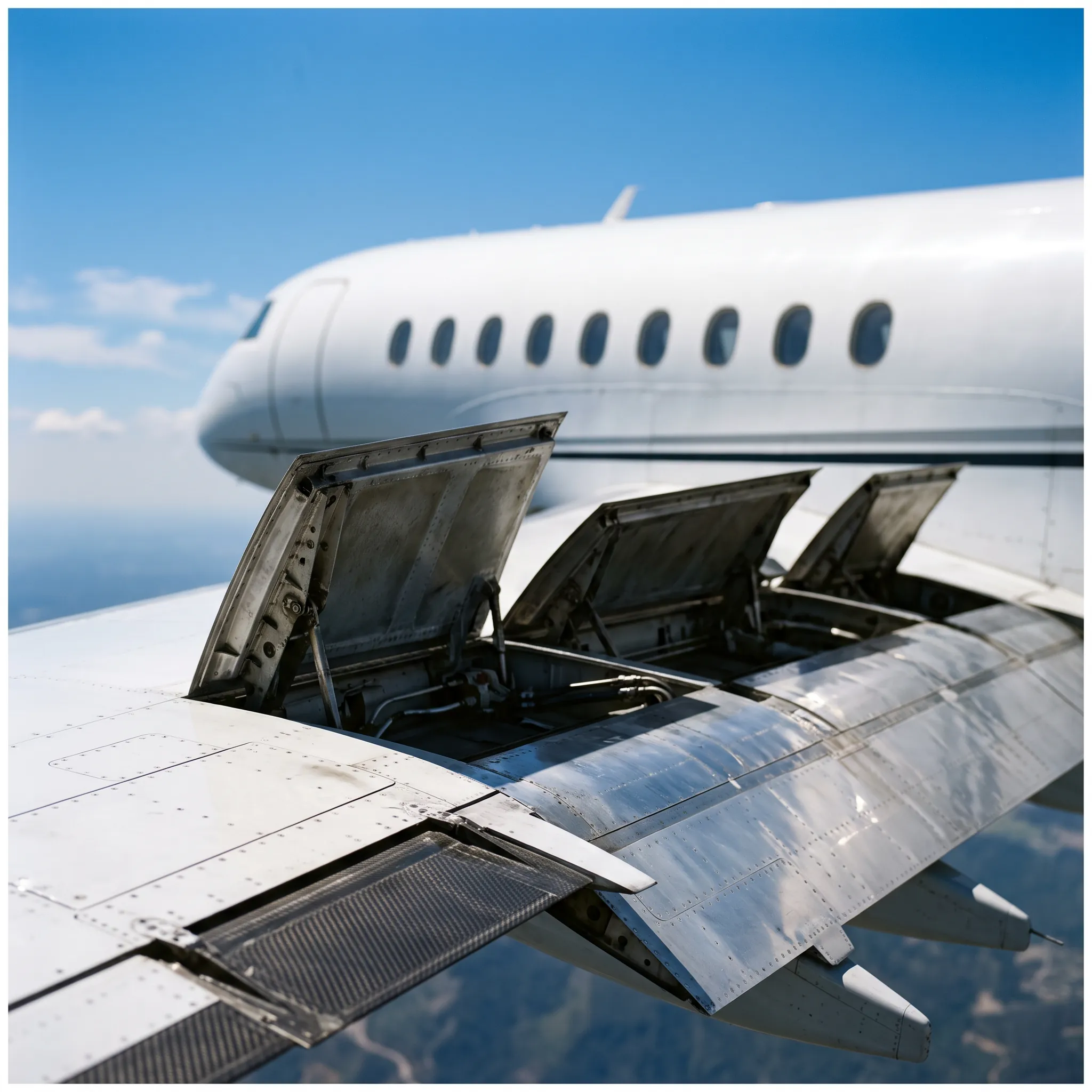
A steeper glide path sounds like a simple change in pilot technique. It isn’t. Descending at that angle generates far more energy and speed than a standard approach, and the aircraft needs specific hardware to manage it safely down to the runway. Manufacturers that pursue this certification typically add:
- Automated airbrake or spoiler systems that deploy earlier and more aggressively to control the steep descent rate
- Modified flap schedules tuned to generate extra drag without sacrificing lift at low speed
- Reinforced landing gear capable of absorbing a firmer touchdown, since steep approaches leave less room to gently flare before the runway
- Revised autothrottle and flight director logic specifically programmed for the steep glide path mode
None of this is retrofit-friendly. It gets engineered into the airframe from the start or added through an extensive, expensive supplemental certification program. That’s why steep approach capability tends to cluster around a short list of specific models rather than spreading across an entire manufacturer’s lineup.
The Aircraft That Actually Qualify
The Dassault Falcon family has long been the benchmark here, largely thanks to its high-lift wing design, a legacy of Dassault’s fighter jet heritage. The Falcon 900 series and Falcon 2000 variants are among the few large-cabin jets cleared for London City. Embraer’s Legacy 600 has also earned steep approach approval, giving midsize jet operators a foothold at these airports too, with select Phenom variants under evaluation for steep approach clearance on an ongoing basis.
| Approach Type | Typical Glide Angle | Example Airport |
|---|---|---|
| Standard | 3 degrees | Most airports worldwide |
| Steep | 4.5 – 5.5+ degrees | London City, Lugano |
| Steep, terrain-restricted | 5.5+ degrees with curved final | Lugano |
The Pilot Training Requirement
Certified hardware only solves half the problem. Regulators treat steep approach flying as a distinct skill, not an extension of standard training, which means the aircraft’s capability is only ever as good as the crew flying it. Pilots who operate into London City or Lugano must complete a dedicated steep approach endorsement, typically earned in a full-motion simulator that replicates the specific glide angle, energy state, and go-around profile of the airport in question. This sits on top of the standard type rating for the aircraft itself.
That endorsement doesn’t last indefinitely. Most operators require recurrent currency checks, often annually, to confirm a pilot can still fly the profile to standard, and many airports layer on their own local requirements. London City, for instance, has historically required the pilot in command to hold specific in-type experience and, in some cases, restricts the approach to captains only rather than allowing a first officer to fly it under supervision. Lugano’s operators add training on the valley’s visual segment and mountain-wave turbulence, since the terrain-following track can’t be fully replicated by glide angle training alone. Crew scheduling for these routes also has to account for the additional duty and currency considerations that come with operating into restricted-access airports.
What This Means for Owners and Charter Buyers
For owners shopping for an aircraft, steep approach capability isn’t a checkbox spec, it’s a filter that immediately narrows the field to a handful of large-cabin and midsize models. For charter and fractional buyers, it explains why a quote for London City or Lugano sometimes comes back with a different aircraft type than expected, or a higher price attached. Operators factor in the cost of maintaining crew currency, the smaller pool of qualified pilots, and often higher landing and handling fees at slot-constrained airports. A glide angle chart won’t tell you any of that. The training and hardware requirements do the explaining.
Owners shopping for a jet capable of London City or Lugano are really shopping from a list of maybe six airframes, and that list won’t grow quickly. The engineering costs too much, the certification process takes too long, and the market for airports this restrictive is too small to justify a broader rollout. Until that changes, the Falcon 900, Falcon 2000, and Legacy 600 will keep defining who gets to fly into two of Europe’s most convenient runways.