
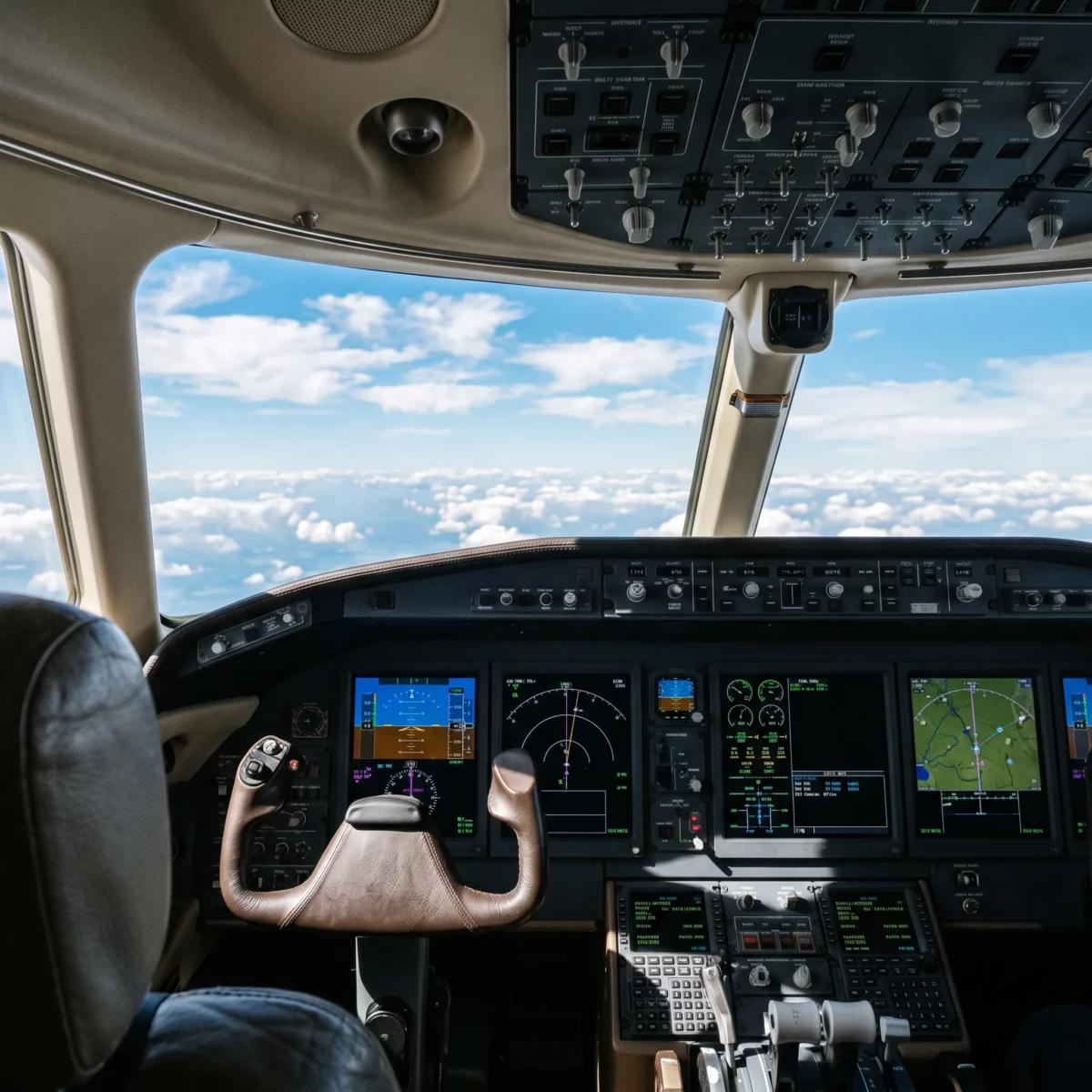
Here’s something that surprises a lot of first-time charter clients: the pilot flying your Citation X this week legally cannot hop into a Gulfstream G650 next week, even if a seat opens up and the schedule is tight. It’s not about experience or seniority. It’s federal law. Every jet over 12,500 pounds or powered by a turbojet engine requires its own separate type rating, and that single rule shapes almost everything about how charter operators staff their flights.
What a Type Rating Actually Is
A type rating is a specific certification tied to one aircraft type, sometimes even one specific variant within a family. It’s issued by the FAA and sits on top of a pilot’s existing commercial or ATP license. Think of it less like a general driver’s license and more like a specialized trade certification. Knowing how to fly a Bombardier Challenger 350 tells you almost nothing about how to fly a Challenger 605, even though they share a manufacturer and a similar silhouette.
Cockpit layouts, systems logic, and emergency procedures can all differ substantially between variants, even ones that look nearly identical from the ramp. A pilot who’s spent 5,000 hours in one jet can feel like a total beginner in another until they’ve completed the required training.

Why the Training Is So Intensive
Getting a new type rating isn’t a weekend course. Pilots typically spend two to four weeks in a dedicated program, often at a facility like FlightSafety International or CAE, running through full-motion simulators that replicate every failure scenario imaginable. Engine fires. Hydraulic failures. Rejected takeoffs at the worst possible moment.
- Ground school: Deep study of the aircraft’s specific systems, avionics, and performance limitations, usually 40 to 80 hours
- Simulator training: Full-motion sessions covering normal operations plus emergency procedures, typically 20 to 40 hours
- Checkride: A formal evaluation with an FAA examiner or designated pilot examiner
- Cost: Often $20,000 to $35,000 per pilot, covered almost always by the operator, not the pilot
That price tag is one reason charter operators think carefully before adding a new aircraft type to their fleet. Every additional model means training every crew member who might fly it, and that cost compounds quickly across a roster of pilots.
Why You Can’t Just Swap Crews
This is where it gets practical for anyone who charters or owns a share of a jet. If your usual crew calls in sick, the operator can’t simply pull the next available pilot from a different aircraft type and put them in the seat. The replacement pilot needs the exact type rating for that exact aircraft, current medical certification, and enough recent flight hours to satisfy currency requirements.
This is exactly why fractional programs like NetJets and Flexjet organize their pilots into fleet-specific pools. A pilot certified on the Praetor 600 stays in that pool. Someone rated on the Global 7500 stays in theirs. Preference has nothing to do with it — the FAA’s rules on type-specific certification make the pool assignment automatic.

Type Ratings by Aircraft Category
| Aircraft Category | Example Model | Typical Training Length |
|---|---|---|
| Light Jet | Citation CJ3+ | 2 weeks |
| Midsize Jet | Challenger 350 | 3 weeks |
| Large Cabin | Gulfstream G650 | 3 to 4 weeks |
What This Means for Charter Reliability
Next time you book a flight and the operator mentions a slightly longer lead time to confirm crew, this is likely why. Reputable operators would rather delay confirmation than assign a pilot who isn’t properly rated on that specific tail number. It’s a safety net built directly into the regulatory structure, and it’s one reason the private aviation industry has maintained such a rock-solid safety record even as flight volume has grown.
It also explains why some smaller operators specialize in just one or two aircraft types instead of running a mixed fleet. Standardizing around a single type rating keeps training costs down and crew scheduling far simpler. Larger operators absorb the cost of multiple type ratings across their pilot workforce because it lets them offer clients more aircraft options, but it’s never cheap, and it’s never instant.
Looking Ahead
As fleets diversify and demand for charter flights continues rising, expect this kind of behind-the-scenes coordination to get more sophisticated, not less. Fractional operators are increasingly investing in software that tracks pilot currency and type-rating status in real time, helping schedulers spot gaps before they affect a trip. For clients, that mostly shows up as a scheduler catching a currency lapse three days out instead of scrambling the morning of departure.