
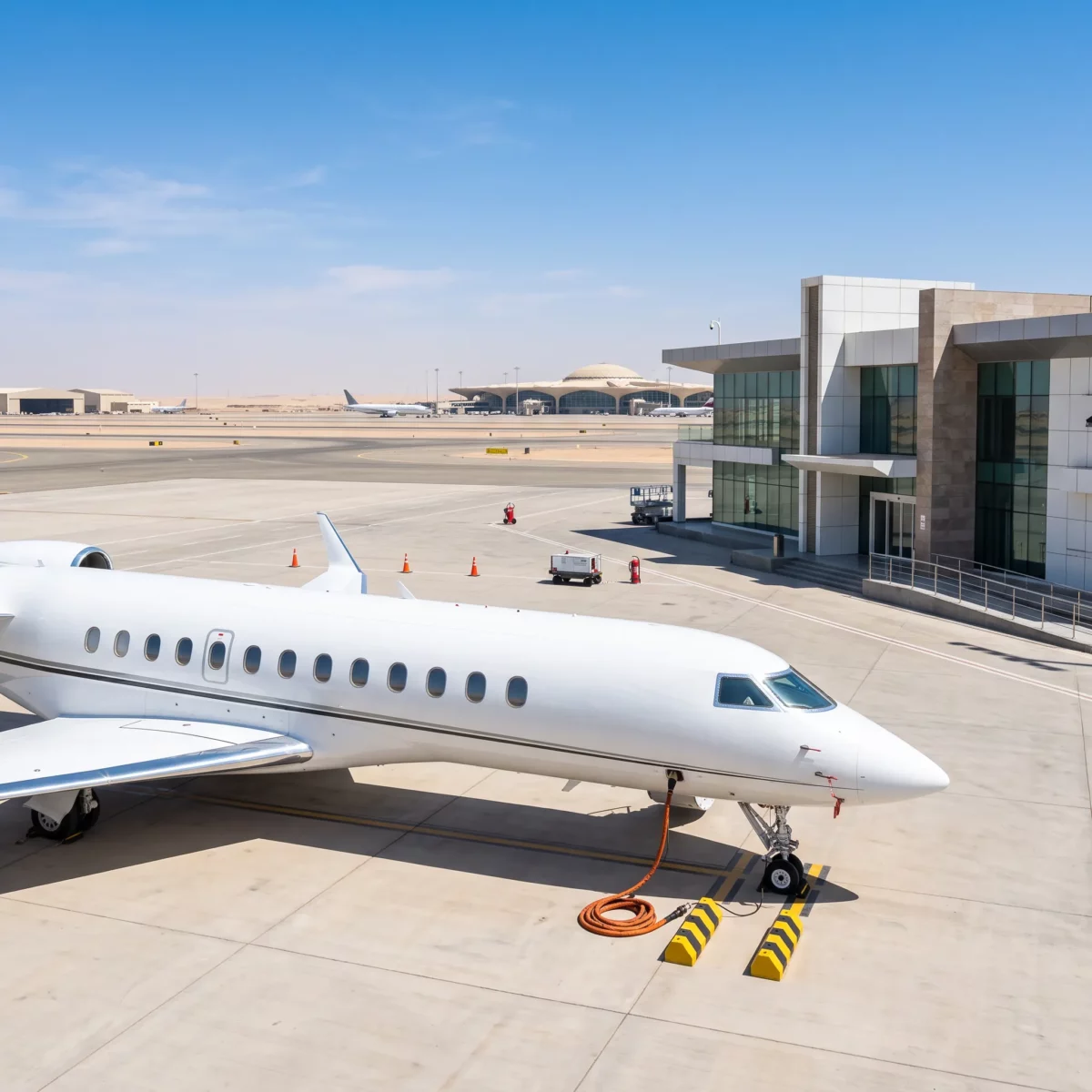
Business aviation just got a permanent address in Saudi Arabia’s Eastern Province. Universal Aviation has opened operations at King Fahd International Airport in Dammam, launching what it calls the Kingdom’s first dedicated general aviation terminal and FBO. For anyone tracking where private aviation is headed next, this one matters more than it might seem at first glance.
Dammam has never had a facility built specifically for private aircraft and their passengers. Business jets landing there previously shared ramp space and processing with commercial traffic, which meant longer waits, less privacy, and none of the polish that owners and charter clients expect elsewhere in the world. That changes now.

Why Dammam, and Why Now
King Fahd International sits close to Dhahran and the broader oil and industrial corridor along the Gulf coast. It is also a gateway for business travelers moving between Riyadh, Bahrain, and the wider region. Saudi Arabia’s push toward economic diversification under Vision 2030 has brought a steady rise in executive and VIP flights into the Eastern Province, and the existing infrastructure simply wasn’t built for that kind of traffic.
A dedicated terminal solves a problem that anyone who flies privately into a commercial-only airport recognizes immediately. Ground handling speeds up considerably. Arriving passengers now clear customs and immigration in a private setting rather than queuing through a shared commercial hall, and crews finally get proper facilities for rest and flight planning instead of squeezing into corners of a terminal built for something else entirely.
What the New Facility Actually Offers
Universal Aviation has built the Dammam FBO around the same service standard the company runs at its other Middle East locations, adapted for a market that’s growing quickly but still maturing. Expect the essentials that matter to owners and operators:
- Dedicated VIP terminal separate from commercial passenger flow
- Expedited customs and immigration processing for arriving crew and passengers
- Ground handling coordination for fueling, catering, and aircraft servicing
- Crew support services including rest facilities and flight planning resources
- Concierge-style assistance for ground transport, hotel arrangements, and onward logistics
None of this is exotic by the standards of Geneva or Teterboro. But for Dammam, it’s a first, and that distinction carries weight for operators who’ve had to plan around the airport’s limitations until now. The kind of consistent ground handling standards that owners take for granted in Europe and North America simply haven’t existed in this market until recently.
Saudi Arabia’s Bigger Aviation Ambitions
Dammam doesn’t exist in isolation. Saudi Arabia has been investing heavily in aviation infrastructure across the board, from the new Riyadh Air commercial carrier to expanded FBO capacity at multiple Kingdom airports. The government has made clear that it wants Saudi Arabia positioned as a regional hub for both business and leisure travel, not just a market that outbound wealth flies through on its way to London or Geneva.
Private aviation infrastructure is a quiet but telling indicator of that ambition. Countries serious about attracting global capital and high-net-worth visitors build the ground infrastructure first, because that’s what sophisticated travelers and their teams notice before anything else. A CEO’s flight department doesn’t care how nice the tourism campaign looks if the FBO experience on arrival is chaotic.
Other markets have seen similar moves. Istanbul’s new VIP terminal repositioned the city as a gateway between Europe and Asia, and Dammam’s opening follows a comparable logic, just applied to the Gulf’s industrial and financial corridor rather than a transcontinental crossroads.
What This Means for Operators and Charter Clients
For charter brokers and flight departments planning trips into eastern Saudi Arabia, the calculus changes. Turnaround times should shorten. Passenger experience improves immediately, particularly for clients unfamiliar with navigating commercial terminal protocols. And operators gain a facility that can actually handle the surge in demand that’s been building for several years.
This also plugs into a broader question worth asking whenever a new market opens up: where private jets can actually land and how well-equipped those airports are matters just as much as the aircraft flying into them. A beautiful cabin means little if the arrival experience on the ground falls apart.
| Before Dammam FBO | After Dammam FBO |
|---|---|
| Shared commercial terminal processing | Dedicated VIP terminal and ramp access |
| Limited crew rest facilities | Purpose-built crew support services |
| Standard customs queue | Expedited immigration for private arrivals |
A Regional Trend Worth Watching
The Gulf has quietly become one of the more active regions in global private aviation infrastructure investment. Saudi Arabia’s push mirrors moves happening across the growth markets reshaping intercontinental private aviation more broadly, where operators and governments alike recognize that ultra-wealthy travelers increasingly choose destinations based partly on how smoothly they can arrive and depart.
It would be no surprise if Jeddah or NEOM saw similar FBO investment next, given Universal Aviation’s existing regional footprint and Saudi Arabia’s broader airport buildout tied to Vision 2030. The Dammam terminal may end up being an early test case for how quickly the Kingdom can scale this kind of infrastructure elsewhere.