
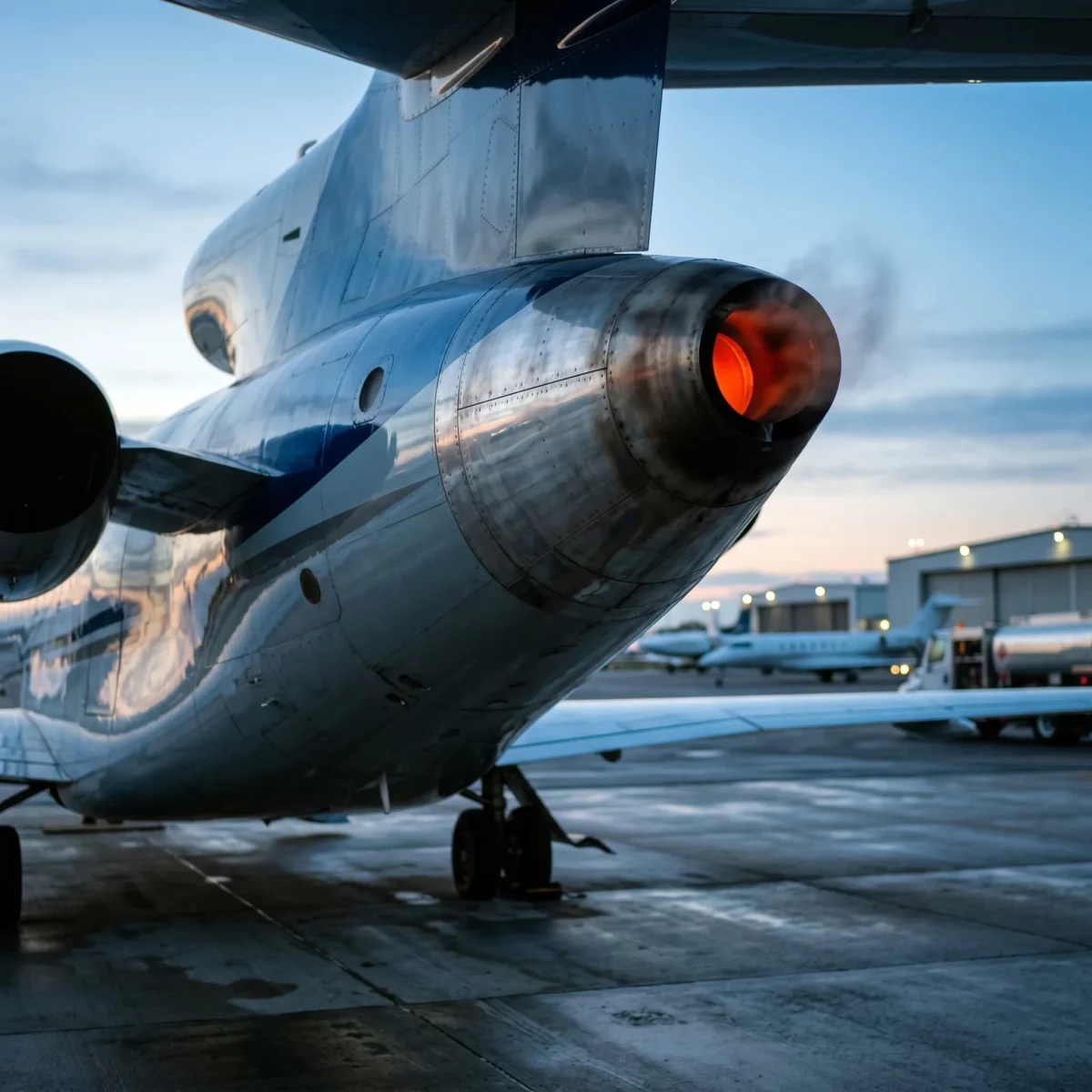
You board your Gulfstream G650 on a sweltering August afternoon in Miami. The cabin is already cool. The reading lights are on. The galley is humming. The crew is ready. And yet the main engines are completely silent. Something else is running, and most passengers never think to ask what it is.
That something is the Auxiliary Power Unit, or APU. It’s a small gas turbine engine, typically tucked into the tail cone of the aircraft, and it’s the reason your private jet feels alive long before it ever leaves the ground.
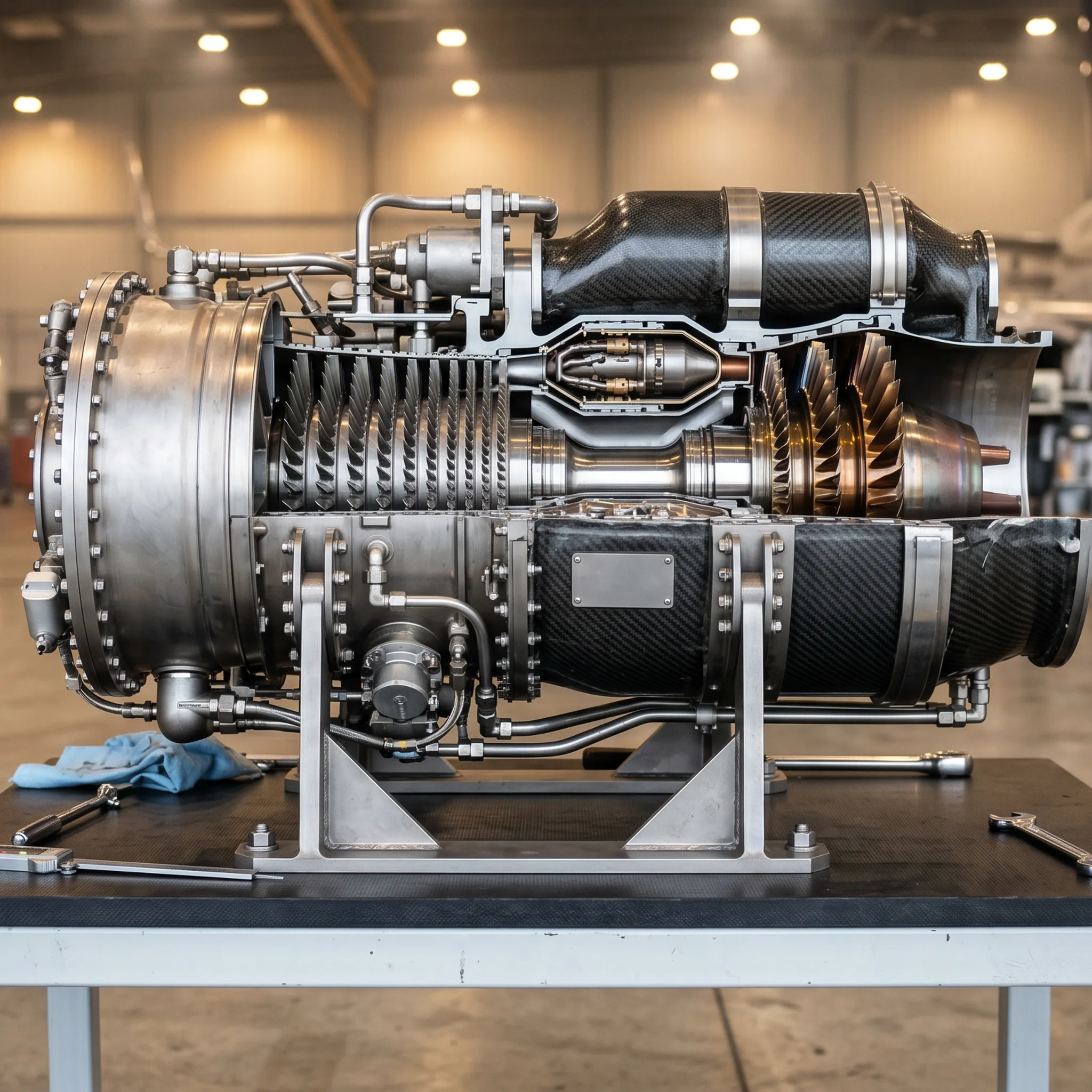
What the APU Actually Is
Think of the APU as a self-contained power plant built specifically for ground operations. It’s a dedicated gas turbine, much smaller than the main engines but operating on the same basic principles. It burns Jet-A fuel, spins a generator, and produces two things your aircraft needs before departure: electrical power and compressed air.
On most business jets, the APU sits in the tailcone section at the rear of the fuselage. You’ll often see a small exhaust port near the tail. That’s the APU venting its combustion gases. If you’re on the ramp and smell a faint whiff of jet exhaust even though the main engines are cold, the APU is already running.
Common APU manufacturers include Honeywell and Pratt and Whitney Canada, whose units power everything from midsize jets to large-cabin aircraft like the Bombardier Global 7500. The APU doesn’t move the aircraft. That’s not its job. Its job is to make everything else possible.
The Two Things It Gives You
An APU delivers two distinct outputs, and both matter enormously to the experience you have on board.
Electrical Power
The APU drives an onboard generator that supplies all the electricity the aircraft needs while parked. Cabin lighting, avionics initialization, entertainment systems, galley equipment, charging ports, the flight crew’s navigation briefing displays. All of it draws from the APU while the main engines sit cold.
Without the APU running, a parked aircraft either pulls power from a Ground Power Unit, or GPU, which is a mobile generator the FBO connects via a cable, or it sits dark and quiet. Most private jets prefer the APU precisely because it eliminates that dependency. You’re not waiting for an FBO technician to connect equipment. The jet is self-sufficient.
Compressed Air for Cabin Comfort
This is where the APU earns its reputation as the backbone of pre-flight comfort. The engine also functions as an air compressor, producing high-pressure bleed air that feeds directly into the aircraft’s Environmental Control System, or ECS. The ECS uses that compressed air to condition the cabin, regulating temperature and maintaining a comfortable atmosphere before a single main engine comes online.
On a brutally hot tarmac in Dubai or Phoenix, this matters more than almost any other mechanical system on the aircraft. The APU is what greets you with conditioned air the moment you step through the cabin door.

The Role of the APU in Engine Start
Here’s where things get genuinely interesting from an operational standpoint. Starting a large turbofan engine requires a significant initial burst of compressed air to spin the engine’s core fast enough to achieve ignition. The main engines can’t produce that airflow themselves from a standing start. They need help.
The APU provides exactly that. When the crew initiates an engine start sequence, the APU routes pressurized bleed air into the main engine’s pneumatic starter motor, spinning the turbine sections until the engine reaches self-sustaining RPM and lights off. Once both main engines are running and generating their own power and bleed air, the APU automatically unloads and can be shut down.
The sequence happens in minutes, but the choreography is precise. The crew typically runs through APU checks, verifies adequate bleed air pressure, then starts engines one at a time. It’s one of the most routine procedures in aviation, executed on thousands of business jets every day, and the APU makes all of it possible.
When the APU Stays Running
Not every operation follows the same script. At some remote airports, or when the crew anticipates a quick turnaround, the APU may run continuously from pushback through engine start. On some aircraft and operator procedures, the APU remains available as a backup power source even after main engine start, available to step in if a generator trips offline unexpectedly.
- Pre-flight power: APU provides electrical power for avionics setup, lighting, and crew systems from the moment technicians begin pre-flight prep, often 90 minutes or more before departure
- Cabin conditioning: APU-supplied bleed air keeps the cabin at the desired temperature throughout boarding, regardless of outside conditions
- Engine starting: APU bleed air provides the pneumatic pressure necessary to spin up and ignite each main engine
- GPU independence: APU eliminates the need for external ground power connections, simplifying operations at any FBO or remote location
- Backup power capability: On many aircraft, the APU remains available in flight as an emergency electrical power source
APU vs. Ground Power: What the Crew Knows
Flight crews and operators make deliberate choices about APU use. At busy FBOs with excellent ground support, connecting a GPU and using external ground conditioning equipment can be more fuel-efficient than running the APU, particularly for extended ground times. The APU burns fuel the entire time it operates, typically somewhere between 100 and 200 pounds per hour depending on the aircraft size and power demands.
For shorter ground times, or at airports where GPU equipment is unreliable or unavailable, the APU simply makes more sense. It’s faster to start, eliminates cable connections, and gives the crew complete control over cabin environment without coordinating with ground handlers.
On remote or international trips, the APU’s value becomes impossible to overstate. Touch down at a small airfield in the Caribbean or a secondary European airport, and there may be no ground power available at all. The APU makes that a non-issue. The jet remains fully functional on its own resources.

What This Means for You as a Passenger
You’ll never interact directly with the APU. You won’t flip a switch or adjust a setting. But you experience its output constantly during the boarding process, the pre-departure wait, and those first minutes of taxi when the main engines are just coming online.
The next time you board your aircraft and find the cabin already at 68 degrees with the reading lights glowing and the coffee brewing, that’s the APU at work. It started running well before you arrived. It will keep running until the main engines are stable and self-sufficient. Then it will quietly step aside, its job complete.
Understanding the APU changes how you think about private aviation reliability. Your aircraft isn’t dependent on the infrastructure of wherever you’re parked. It carries its own power plant, its own conditioning capability, and its own engine-starting energy. That self-sufficiency is a core part of what makes private jets genuinely different from any other form of travel, and the APU is the system that makes it real.