

The super-midsize category is where private aviation gets interesting. These jets cross continents without the operating costs of heavy iron. They land at smaller airports that the big ultra-long-range jets can’t reach. And in 2026, four aircraft dominate the conversation: the Bombardier Challenger 3500, Embraer Praetor 600, Gulfstream G280, and Cessna Citation Longitude.
Each brings something different to the table. The question is which combination of range, cabin space, and operating economics makes sense for your mission profile.
The Challenger 3500: Cabin Space Champion
Bombardier’s Challenger 3500 owns the cabin space race in this category. With 1,073 cubic feet of cabin volume, it feels closer to a large cabin jet than a super-mid. The cabin stretches 25.3 feet long and stands 6.1 feet tall. You can walk through without ducking.
Range clocks in at 3,400 nautical miles, enough for New York to London with favorable winds or Los Angeles to New York nonstop. The cabin typically seats eight in a double-club configuration, though you can push it to ten if needed. What owners rave about is the workspace. The flat floor and wide cabin make it easy to move around during flight.
Operating costs run higher than the other three, mainly because it’s the heaviest aircraft in the group. But if cabin space tops your priority list, nothing else in this category comes close.
The Praetor 600: Range King
Embraer’s Praetor 600 wins the range battle outright. It delivers 4,018 nautical miles of range, making it the only super-midsize jet that can reliably cross the Atlantic westbound against headwinds. London to New York becomes routine. Miami to Buenos Aires opens up without a fuel stop.
The cabin measures 973 cubic feet, smaller than the Challenger but still generous. What Embraer nailed is the details. The turbulence reduction system adjusts flight controls automatically for a smoother ride. The cabin altitude stays at 5,800 feet when cruising at 45,000 feet, lower than its competitors. Passengers notice the difference on longer flights.
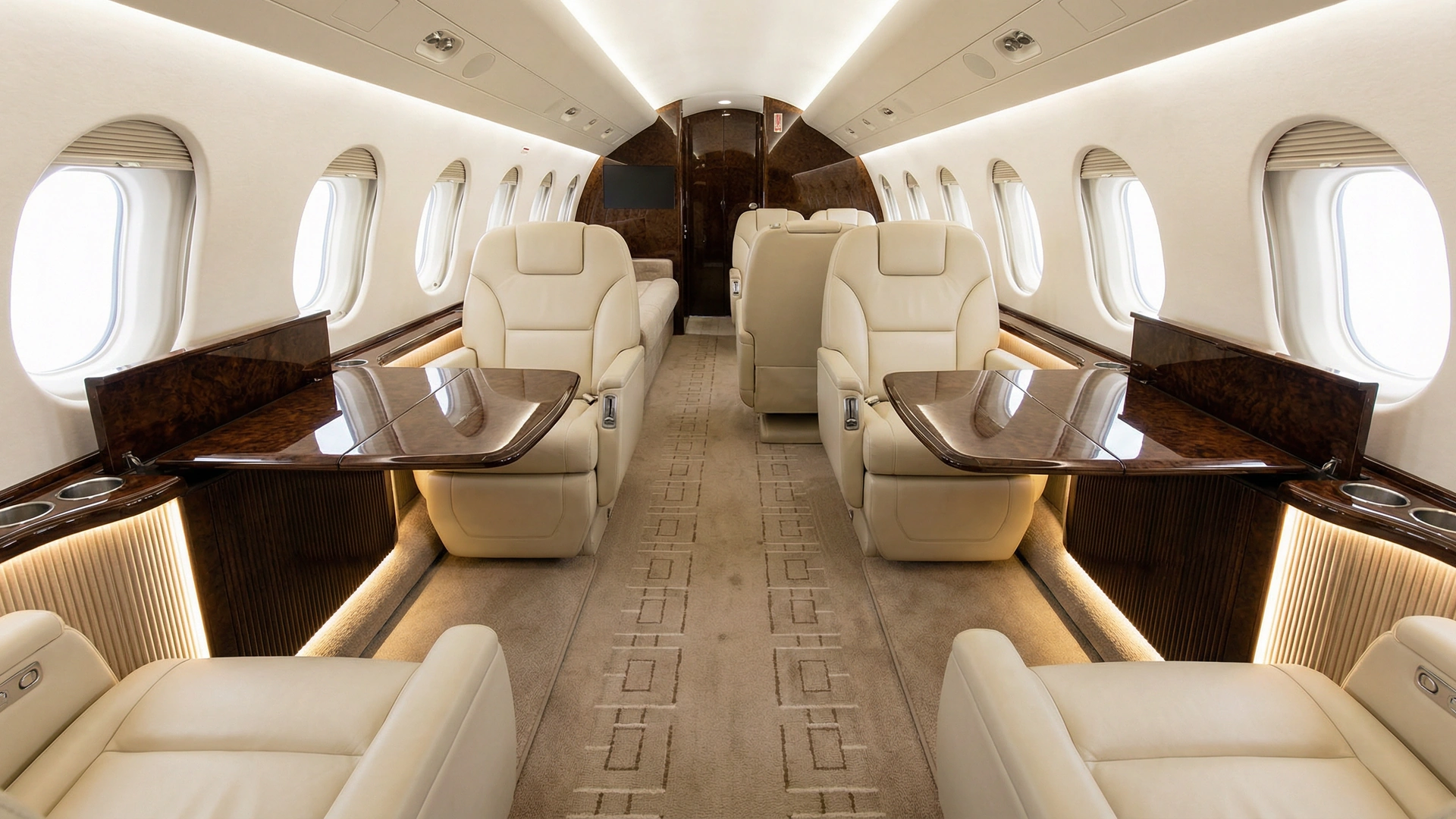
Direct operating costs sit in the middle of this group. For buyers who need true transcontinental and transatlantic capability without stepping up to a large cabin jet, the Praetor makes compelling sense.
The G280: Speed and Efficiency
Gulfstream’s G280 takes a different approach. It prioritizes efficiency and speed over pure cabin volume. The 935 cubic feet cabin is the smallest here, but Gulfstream’s design team makes every inch count. The cabin management system and the seats feel unmistakably Gulfstream.
Range hits 3,600 nautical miles, splitting the difference between the Challenger and the Praetor. But the G280 cruises fast. It maintains Mach 0.85 efficiently, shaving meaningful time off longer flights. The PlaneView 280 cockpit gives pilots some of the best avionics in the business aviation world.
Where the G280 really shines is operating costs. It burns less fuel than the Challenger and costs less to maintain than you’d expect from Gulfstream. For buyers who value the brand, the support network, and don’t need the largest cabin, it deserves serious consideration.
The Longitude: Value Play
Cessna’s Citation Longitude enters this fight with a sharp price advantage. List price runs several million below the other three. That matters when you’re writing the check or calculating fractional share costs.
The cabin delivers 931 cubic feet and seats up to nine passengers. Range reaches 3,500 nautical miles. The numbers look competitive on paper. What the Longitude offers is predictability. Cessna’s service network blankets the globe. Parts availability rarely becomes an issue. Pilots who’ve flown Citations know what to expect from the handling.
Operating costs come in lowest of the four, mainly thanks to efficient engine performance and lower maintenance requirements. For charter operators and fractional providers, those economics make the Longitude attractive. For individual owners who fly frequently, the fuel savings add up.
The Operating Cost Reality
Direct operating costs separate these aircraft more than buyers often realize. The Challenger 3500 typically runs around $3,800 per flight hour. The Praetor 600 and G280 both hover near $3,400 to $3,500 per hour. The Longitude drops to roughly $3,200 per hour.
Over 300 hours of annual flying, those differences compound. But operating costs tell only part of the story. Acquisition price, residual value projections, and support network quality all factor into the total ownership equation.
Which Jet for Which Buyer?
The Challenger 3500 suits buyers who prioritize cabin experience and frequently fly with larger groups. If you regularly have six to eight passengers and want everyone comfortable for cross-country flights, the extra space justifies the premium.
The Praetor 600 makes sense for true international missions. Flying regularly between the U.S. and Europe, or covering long routes in Latin America or Asia, you need that extra range. The superior cabin altitude becomes more than a spec sheet number on eight-hour flights.
The G280 appeals to buyers who want the Gulfstream name and support network without large cabin jet costs. If your typical mission involves four to six passengers on coast-to-coast or regional international flights, the cabin size suffices and the efficiency pays dividends.
The Longitude fits budget-conscious buyers and high-utilization operators. If you’re flying 400-plus hours annually, or operating a charter business where every dollar of operating cost matters, the Longitude’s economics become hard to ignore.
The 2026 Market Reality
All four manufacturers report strong order books heading into 2026. Lead times vary, but expect six to twelve months for most positions. The pre-owned market offers alternatives, particularly for the G280 and earlier Challenger variants, though super-midsize inventory stays tight.
Buyers shopping this category today face better options than ever before. The gap between these four jets has narrowed to the point where mission profile and personal priorities matter more than any objective performance ranking. There’s no wrong answer here, just different answers for different needs.