
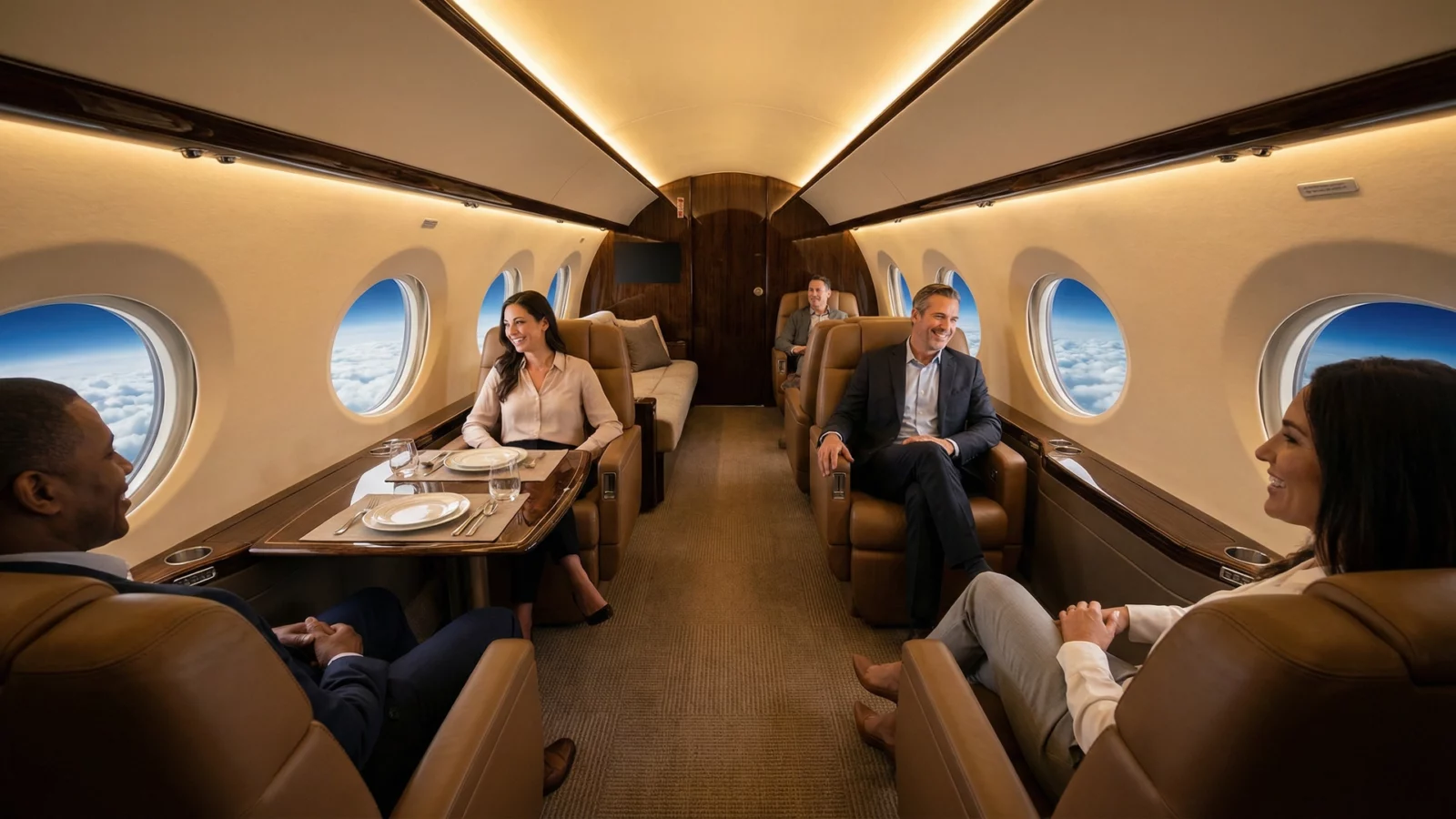
You’ve probably noticed it. After a transatlantic flight on a commercial airliner, you step off feeling dehydrated, headachy, vaguely exhausted. The same flight on a Gulfstream or Global, and you walk off ready for dinner. The difference isn’t just the champagne and the lie-flat seat. It’s physics.
The secret lies in something called cabin altitude. And understanding it changes how you think about what you’re actually buying when you book a private jet.
What Cabin Altitude Actually Means
Aircraft cabins are pressurized. You know this. But here’s what most passengers don’t realize: the air pressure inside the cabin at 45,000 feet doesn’t match sea level. It can’t. Instead, manufacturers design cabins to simulate a lower altitude while the aircraft cruises much higher.
Commercial airlines typically maintain a cabin altitude of 6,500 to 8,000 feet, even when the aircraft flies at 38,000 to 42,000 feet. Think about visiting Denver at 5,280 feet. Some people feel it immediately. Now imagine spending eight hours at 8,000 feet while sitting still, breathing recirculated air. Your body notices.
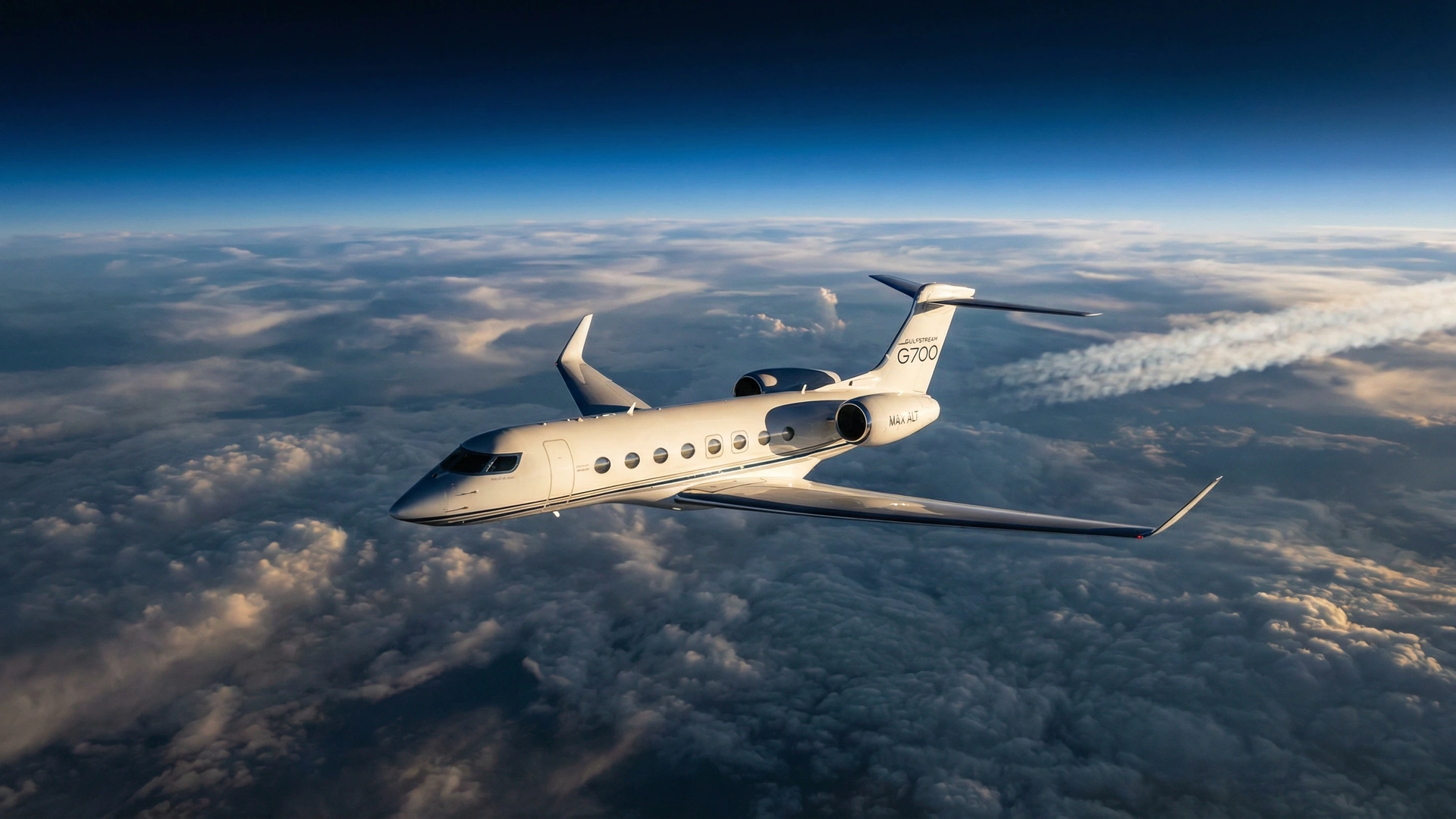
Ultra-long-range private jets change this equation. The Gulfstream G700 maintains a cabin altitude of just 4,850 feet while cruising at 51,000 feet. The Bombardier Global 7500 holds cabin altitude at 2,900 feet at its maximum operating altitude of 51,000 feet. That’s lower than Park City, Utah.
The Maximum Differential Pressure Metric
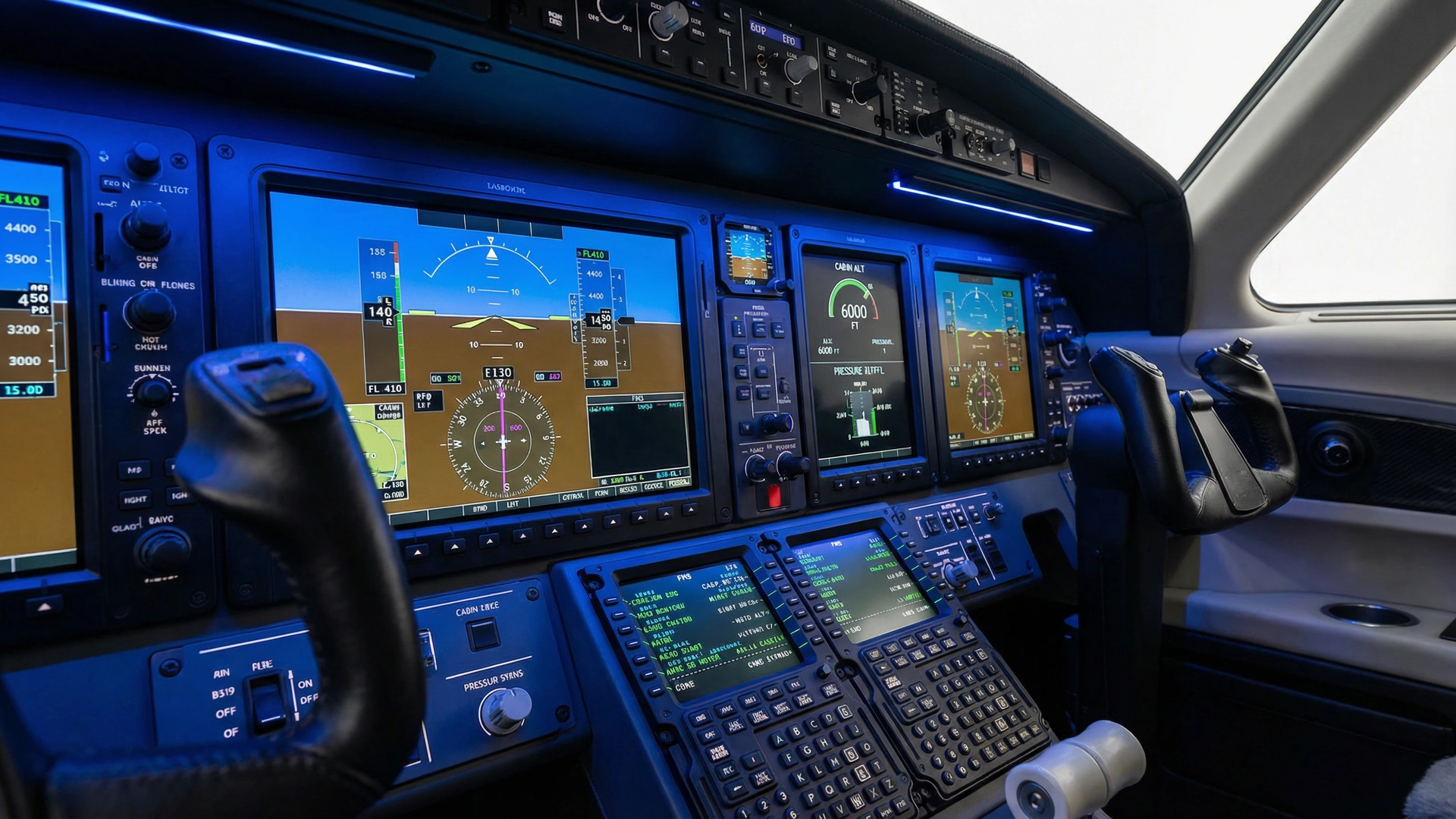
The limiting factor is something engineers call maximum differential pressure, usually abbreviated as max diff pressure or just diff pressure. This measures the difference between the air pressure outside the fuselage and the pressure inside the cabin.
At 45,000 feet, the outside air pressure drops to about 2 pounds per square inch. Sea level pressure sits at 14.7 psi. To maintain a cabin altitude of 8,000 feet (roughly 10.9 psi), the aircraft needs to hold a differential of about 8.9 psi. To maintain 5,000 feet (12.2 psi), you need a differential closer to 10.2 psi.
Every additional psi of differential pressure puts more stress on the fuselage. The structure has to be stronger, which means heavier, which means more engineering complexity and cost. Commercial aircraft typically max out at 8.0 to 9.0 psi differential. Ultra-long-range business jets push this to 10.0 psi or higher.
The Gulfstream G650ER holds 9.4 psi. The G700 bumped it to 10.6 psi. The Global 7500 runs at 10.9 psi. These numbers sound small. The difference in how you feel after landing is not small at all.
Why This Costs Real Money
Building a fuselage that can handle 10.9 psi differential requires advanced materials, more robust structural engineering, and more rigorous testing. Bombardier had to reinforce the Global 7500’s entire pressure vessel. Gulfstream developed new manufacturing techniques for the G700’s fuselage barrel sections.
This engineering adds weight, which cuts into range and payload. It adds cost, which shows up in the purchase price. A Global 7500 lists at around $78 million. A G700 starts near $81 million. You’re paying for that extra psi of cabin pressure.
The Physiological Reality
Your body runs on oxygen. At higher altitudes, even in a pressurized cabin, the partial pressure of oxygen drops. You absorb less oxygen with each breath. Your blood oxygen saturation decreases slightly. Not enough to be dangerous, but enough that your body compensates by working harder.
At a cabin altitude of 8,000 feet, blood oxygen saturation typically drops to 91-94% in healthy adults. At sea level, it’s 95-100%. That small difference, sustained for hours, contributes to fatigue, dehydration, headaches, and that general feeling of being wrung out.
At 5,000 feet, saturation stays closer to 94-96%. At 3,000 feet, you’re barely different from sea level. The closer you stay to sea level pressure, the better you feel. It’s measurable, repeatable, and why passengers consistently report feeling better after flying on aircraft with lower cabin altitudes.
The Altitude Advantage
Here’s where it gets interesting. Private jets don’t just fly higher to avoid traffic. They fly higher because the air is thinner, which means less drag, which translates to better fuel efficiency and longer range. A Gulfstream G650ER cruising at 51,000 feet burns significantly less fuel per nautical mile than the same aircraft at 41,000 feet.
But flying higher also increases the differential pressure requirement. To maintain a comfortable cabin altitude at 51,000 feet, you need a stronger fuselage than you would at 41,000 feet. This is why cabin altitude performance directly ties to maximum operating altitude.
Commercial aircraft face the same physics, but the economics differ. An A320 or 737 optimizes for cost per seat mile. Strengthening the fuselage to achieve lower cabin altitudes adds weight and expense that airlines won’t pay for. An ultra-long-range business jet optimizes for passenger comfort and range. The economics support the engineering investment.
What This Means for Your Next Flight
When you’re comparing aircraft for a transatlantic or transpacific flight, cabin altitude matters as much as seat configuration or cabin width. A Challenger 350, excellent aircraft that it is, maintains an 8,000-foot cabin altitude. A Global 7500 on the same route holds it at 2,900 feet. After 12 hours, you’ll feel the difference.
Charter operators and fractional programs don’t always advertise this. The spec sheets list it, usually buried in the technical data. Ask about it. If you’re flying New York to Dubai or Los Angeles to Tokyo, cabin altitude directly affects how you feel when you land.
The private aviation market in 2026 increasingly recognizes this. Buyers prioritize cabin altitude alongside range and speed. Operators market it to clients who’ve experienced the difference firsthand. And manufacturers keep pushing the envelope, literally, designing fuselages that can handle more pressure so passengers can feel better at altitude.
The physics are simple. The engineering is anything but. And the difference between arriving exhausted and arriving ready to work is worth understanding when you’re choosing how to cross an ocean.