
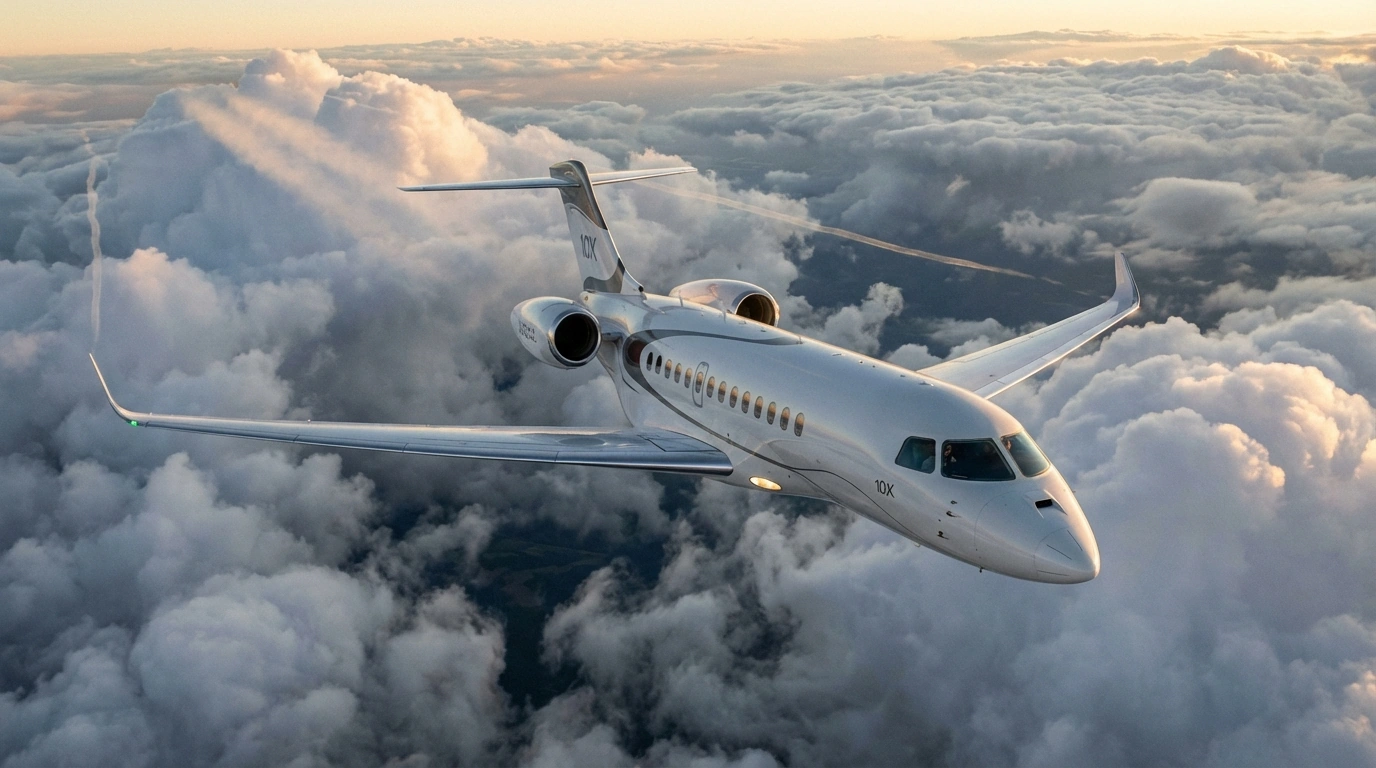
Dassault has spent decades building elegant, nimble business jets. The Falcon 10X is something different. It’s a statement. A direct challenge to the aircraft that have defined ultra-long-range private aviation for the past five years. And if the specs hold up in service, it may genuinely reshape what buyers expect from a top-tier cabin at altitude.
With flight testing expected to begin in 2026 and entry into service targeted for late 2027, the 10X is close enough to evaluate seriously. Here’s what the numbers tell us, and why the cabin story is the one that actually matters.
The Cabin Numbers That Started a Conversation
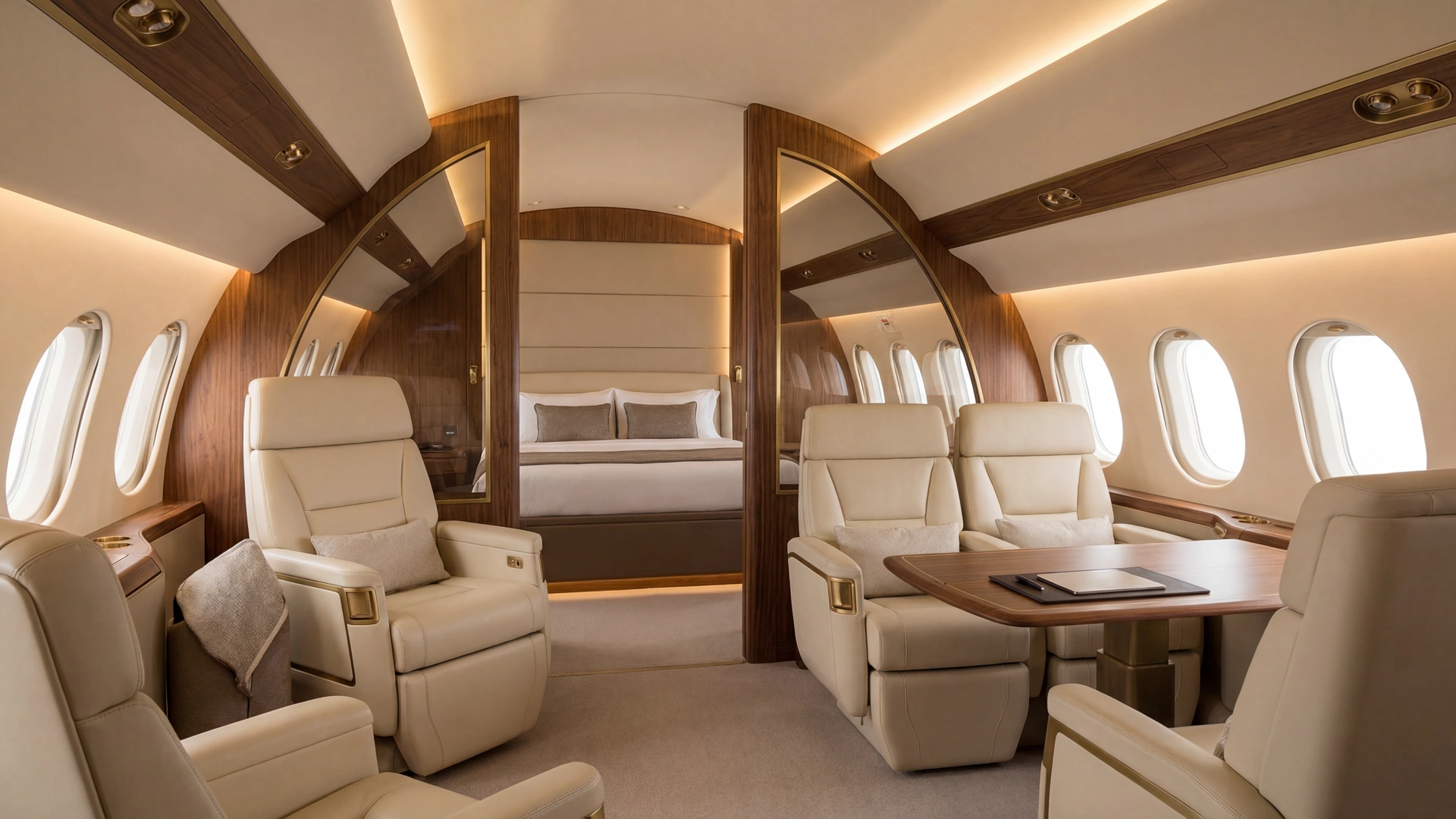
When Dassault published the interior dimensions for the 10X, cabin designers and buyers paid attention. The cross-section measures 6 feet 8 inches tall and 9 feet 1 inch wide. Total volume comes in at 2,780 cubic feet. For context, that ceiling height means most passengers never come close to touching it. You don’t think about the ceiling on the 10X. That sounds small, but it changes everything about how a cabin feels during a 13-hour flight.
The Gulfstream G700 and Bombardier Global 7500 both offer exceptional interiors. They’re genuinely outstanding aircraft. But the 10X widens the cross-section argument in Dassault’s favor. A wider fuselage creates more natural zone separation, more shoulder room, and a subtly different sense of openness that passengers register even if they can’t name exactly why they feel less confined.
Dassault calls the configuration multi-zone living. Private suites, conference areas, and lounge sections can be arranged to suit specific mission profiles. The modularity is the point. A family flying Paris to Singapore configures it differently than a CEO flying New York to Riyadh with a team of advisors. The space allows for that flexibility without compromise.
What 7,500 Miles Actually Means
The 7,500 nautical mile NBAA IFR range figure positions the 10X firmly in the same conversation as the G700 and Global 7500. New York to Dubai nonstop. Los Angeles to Sydney with favorable winds. London to Singapore without a fuel stop.
On missions that long, cabin liveability stops being a luxury concern and becomes a practical one. Passenger fatigue on a 14-hour flight is real. Arrives-exhausted is not a acceptable outcome when you land at a board meeting or a family occasion. Dassault’s emphasis on cabin height and noise attenuation directly addresses that problem. A quieter, more spacious cabin means better sleep, more productive work time, and passengers who step off the aircraft feeling like they actually rested.
The Rolls-Royce Pearl 10X engines deliver over 18,000 lbs of thrust each. Beyond raw performance, they’re engineered for 100% Sustainable Aviation Fuel compatibility. That SAF capability is becoming a genuine purchase criteria, not just a marketing point, as operators respond to corporate sustainability commitments and upcoming emission regulations in key markets.
The Flight Deck Dassault Built for What’s Coming
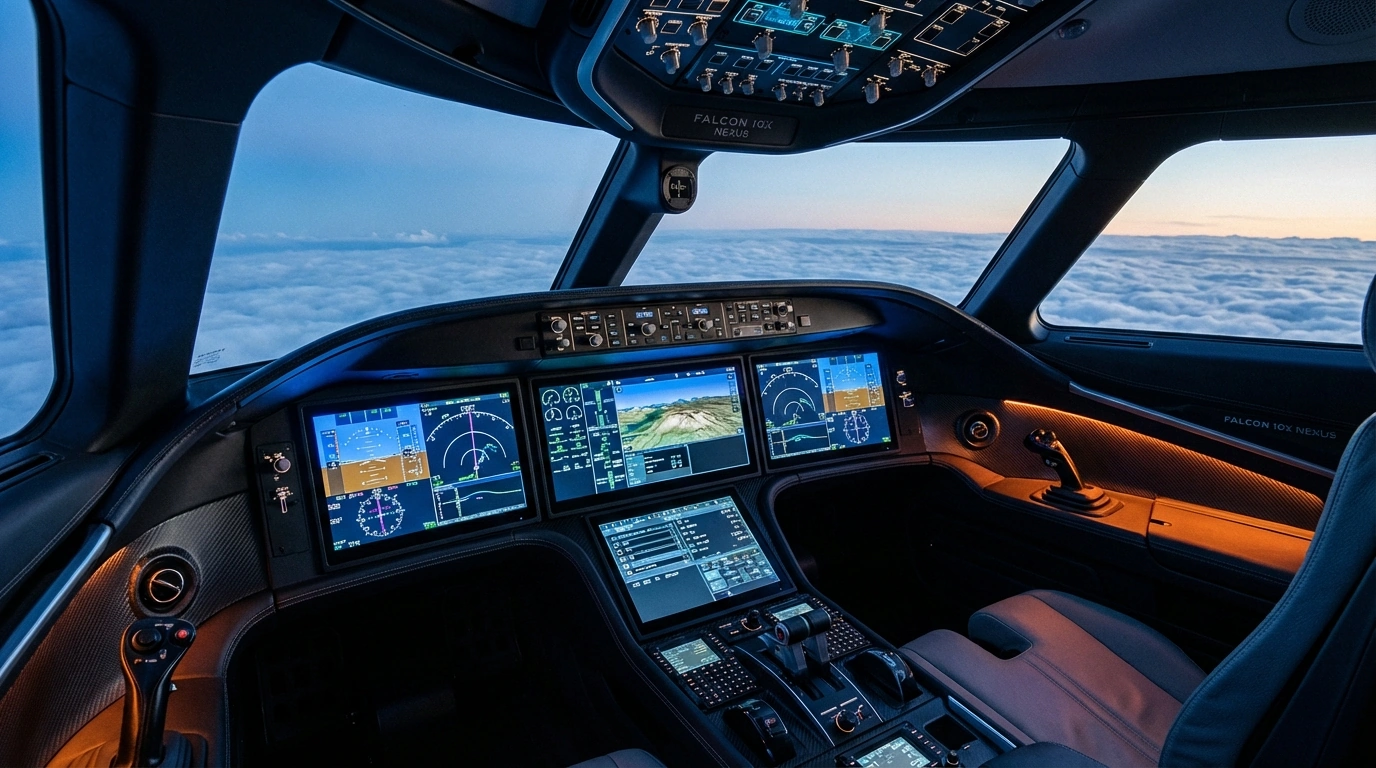
The NeXus flight deck features eight touchscreen displays and integrated digital flight controls. Dassault has always prioritized the pilot experience, and the NeXus cockpit represents their most ambitious avionics integration yet. Eight displays sounds like a lot, but the layout is designed to reduce cognitive load rather than increase it. Information appears where pilots need it, when they need it.
For operators and flight departments evaluating the aircraft, the avionics ecosystem matters beyond the cockpit itself. Integrated digital systems simplify maintenance diagnostics, improve dispatch reliability, and connect more cleanly with modern flight operations software. Those operational details influence total cost of ownership in ways that don’t show up in the brochure specs.
The maximum operating speed of Mach 0.925 keeps the 10X competitive on speed as well. On a transatlantic or transpacific mission, that cruise speed advantage compounds. Faster arrival on a 14-hour flight isn’t trivial for passengers or crew.
Three Jets, One Very Competitive Segment
The ultra-long-range segment has never been more competitive. The Global 7500 defined a new benchmark when it entered service and has held that position with strong customer satisfaction scores and impressive real-world range performance. The G700 pushed Gulfstream’s flagship to new heights in cabin configuration and technology. Both are excellent aircraft with established service networks and loyal operators.
Where does the 10X fit? Dassault is betting the cabin cross-section argument wins over buyers who prioritize the passenger experience above all else. That’s a defensible position. The 10X’s wider fuselage is a structural reality that competitors can’t simply software-update their way around. It’s baked into the airframe. For buyers who’ve flown the Global 7500 and G700 and want something that feels different, not just newer, the 10X offers a genuinely distinct proposition.
Pricing hasn’t been publicly confirmed, but analysts place the 10X in the $75 million to $80 million range at list. That puts it square in the same acquisition bracket as its primary competitors. At that price point, the decision comes down to mission profile, cabin preference, and brand affinity. All three factors favor different buyers.
What Buyers Should Watch Between Now and 2027
Flight testing in 2026 will tell us what the certification timeline actually looks like. Dassault has a strong track record on delivering aircraft close to their projected schedules, which helps. But ultra-long-range aircraft development is complex, and any technical surprises during testing can push timelines.
Range and speed figures published before certification are NBAA IFR estimates. Real-world operators will watch the actual range performance in varied conditions closely. The 10X’s stated figures are competitive on paper. Validation in testing is what converts interested buyers into depositors converting to purchase agreements.
For anyone evaluating the top end of the ultra-long-range market right now, the 10X is a serious reason to wait. If the cabin delivers what the specs suggest, and if the range performance holds, Dassault won’t just have a competitor to the G700 and Global 7500. They’ll have an argument that’s hard to ignore.