
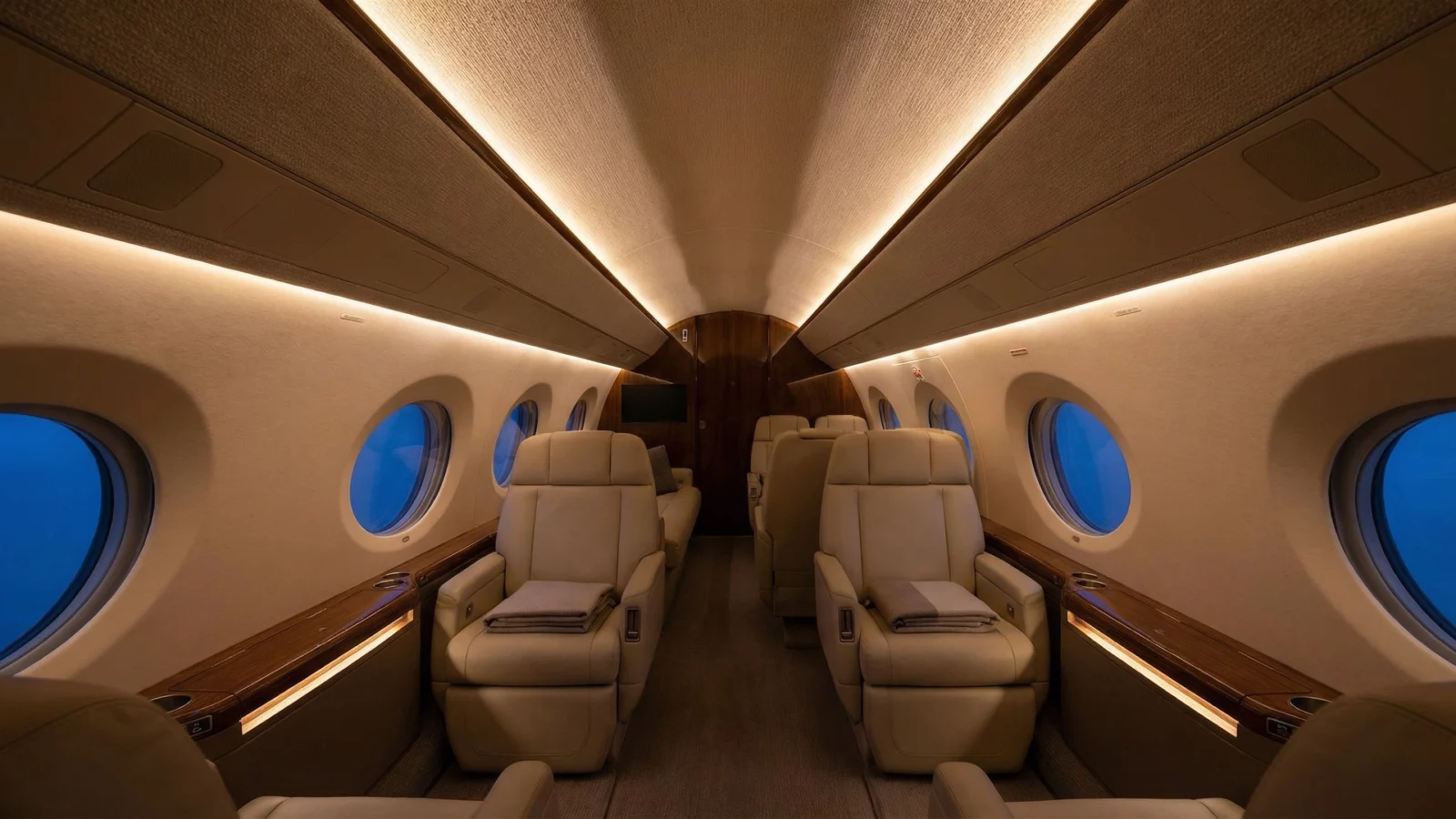
Step aboard a Gulfstream G700 or a Bombardier Global 7500 and something hits you before the leather, the lighting, or the panoramic windows. It’s the quiet. Not silence exactly, but a hush so complete it feels almost engineered. Because it is. Every decibel you don’t hear on a long-haul flight is the result of years of acoustic research, layered materials science, and technology borrowed from industries you’d never expect.
Cabin noise is one of those specifications that doesn’t make the brochure headline but ends up mattering more than almost anything else over a 14-hour flight from New York to Dubai. Here’s why that matters, and how the best manufacturers actually do it.
What Decibels Actually Do to Your Body
A commercial airline cabin typically sits between 80 and 85 dB during cruise. That’s roughly equivalent to a busy restaurant or a garbage disposal running in the next room. Your brain isn’t consciously registering it as loud, but it’s working hard to filter it out the entire flight. That cognitive load translates directly to fatigue.
Research from sleep science confirms that sustained noise above 55 dB disrupts the deeper restorative stages of sleep, even when a person reports sleeping through it. On a transatlantic crossing, the difference between arriving refreshed and arriving depleted often comes down to what was happening acoustically while you slept. For private aviation buyers who fly frequently and work demanding schedules, that’s not a comfort upgrade. It’s a performance metric.
The quietest cabins in business aviation today measure around 48 to 52 dB at cruise altitude. Dassault claims the Falcon 10X cabin holds close to 48 dB during cruise, a figure that puts it roughly on par with a quiet library. Gulfstream targets the low 50s for the G700. The difference between 52 dB and 80 dB isn’t a slight improvement. It’s like comparing two fundamentally different environments.
Passive Insulation: The Foundation Layer
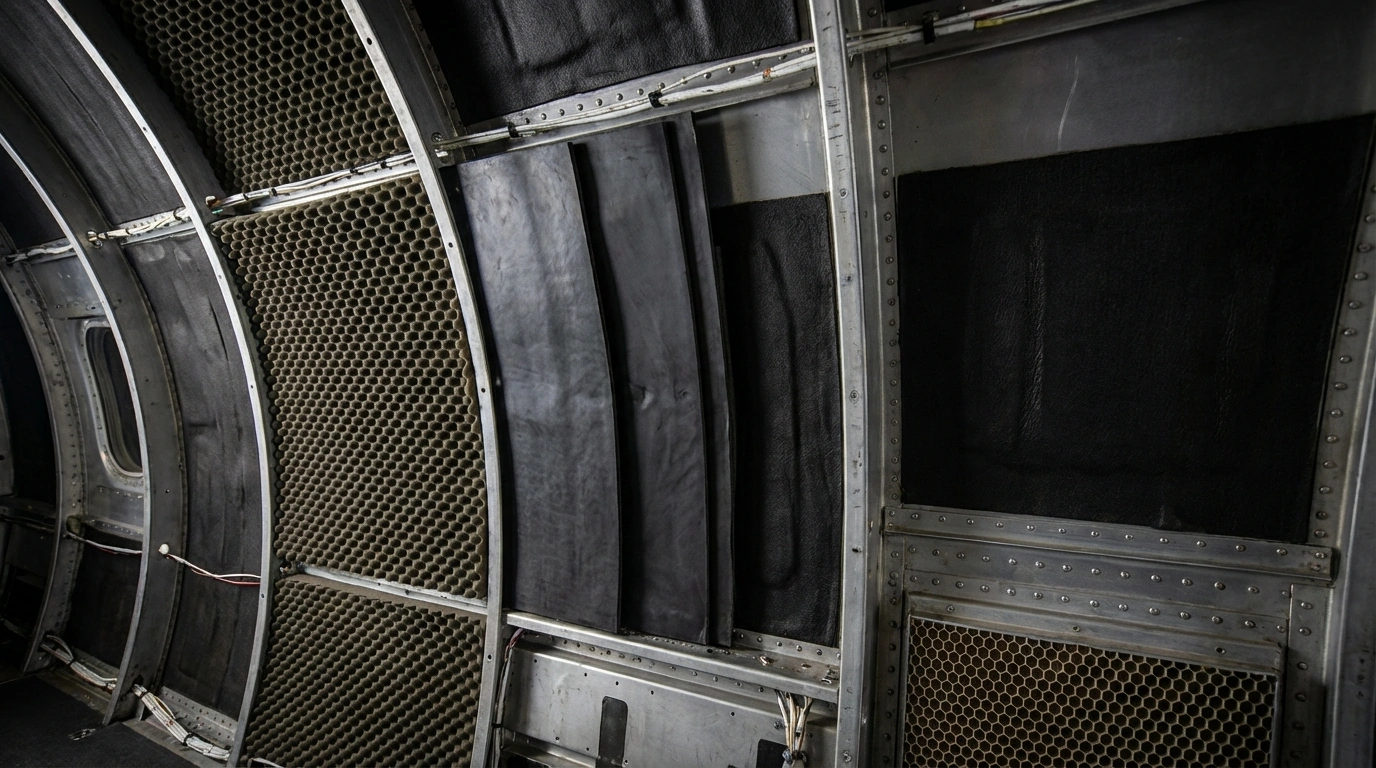
Every acoustic system in a modern private jet starts with passive insulation, the physical materials that block, absorb, and dampen sound before it ever reaches the cabin wall. Think of it as the aircraft’s equivalent of a recording studio’s isolation treatment, except it has to survive pressurization cycles, extreme temperature swings, and decades of service.
Manufacturers use a combination of materials in multiple layers. Mass-loaded vinyl, a dense flexible material, handles high-frequency noise. Acoustic foam absorbs mid-range frequencies. Viscoelastic damping compounds applied directly to the fuselage skin turn vibrational energy into heat before it can propagate as sound. Between the fuselage skin and the cabin interior panels, there’s typically a multi-inch gap filled with acoustic blankets, often made from compressed glass fiber or modern aerogel-based composites that are lighter and more effective than older materials.
The mounting systems matter just as much as the materials. Isolating mounts that float the cabin interior slightly away from the structural frame break that transmission path before it begins. On widebody jets like the Global 7500, Bombardier uses a full floating floor system, meaning the entire cabin floor rests on vibration-isolating pads rather than sitting flush against the aircraft structure.
Active Noise Cancellation at Cabin Scale
Passive insulation handles high and mid-frequency noise well. Low-frequency rumble, the deep drone of turbofan engines at 100 to 300 Hz, is harder to block with physical materials alone. You’d need mass so heavy it would ground the aircraft. This is where active noise cancellation enters the picture.
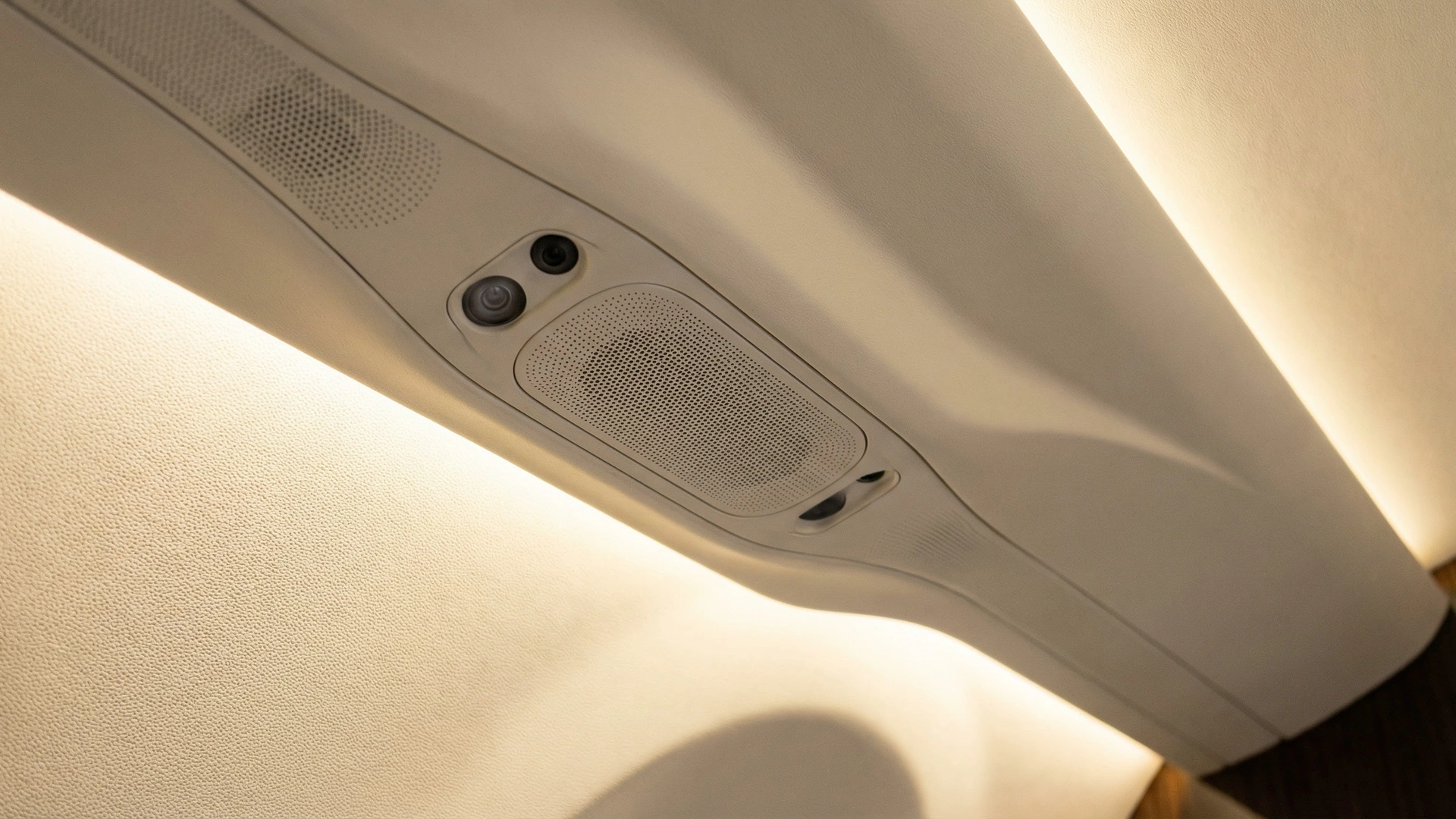
The same principle that makes premium noise-canceling headphones work applies here, just scaled to fill an entire cabin. Microphones mounted throughout the interior sample the ambient noise continuously. A processor analyzes the sound wave in real time and generates an inverse waveform—a signal that is mathematically opposite to the incoming noise. Speakers embedded in the cabin structure emit that inverse signal, and the two waves cancel each other out. What you hear is dramatically reduced engine drone without any of the original disturbance.
Gulfstream has built active noise cancellation into its flagship models for over a decade, refining the system with each new platform. Bombardier takes a similar approach on the Global series. The technology works best on the predictable, steady frequencies produced by turbofan engines at cruise power, which is exactly when passengers are most likely to be sleeping or in a focused meeting. Turbulence and transient sounds are harder to cancel actively, which is why passive insulation still does the heavy lifting across the broader acoustic spectrum.
Where the Real Differences Show Up
Not all quiet cabins are quiet for the same reasons, and understanding the difference matters when you’re evaluating aircraft. A jet that measures 52 dB using an older engine with superior acoustic packaging might actually feel quieter than a newer aircraft with a more efficient powerplant but thinner insulation. The ear doesn’t measure dB. It responds to the character of the noise, not just its level.
Low-frequency rumble is more fatiguing than higher-frequency hiss at the same decibel level. A cabin tuned to eliminate the low end will feel calmer even if the overall measurement is similar to a competitor. This is why walking through a cabin and listening for yourself, on a real flight, not on the ground at an airshow, remains the only reliable evaluation method.
Cabin length and shape also affect acoustics. Longer fuselages like the Global 7500—with its nearly 49-foot cabin—have different acoustic properties than shorter platforms. Sound behaves differently in larger volumes, and manufacturers tune their active cancellation systems specifically to each airframe’s acoustic signature.
What This Means When You’re Choosing an Aircraft
For buyers evaluating long-range platforms, cabin acoustics should sit alongside range, cabin altitude, and connectivity on the comparison checklist. The physiological impact of a quieter environment accumulates over every flight hour you log. On transcontinental or transatlantic routes, that adds up fast.
Ask manufacturers for measured cabin dB figures, not just descriptions like “whisper-quiet.” Ask specifically at what phase of flight the measurement was taken, at cruise power rather than on the ground. And if you have the opportunity, schedule a demo flight rather than a static walk-through. Two aircraft that look identical on a spec sheet can feel worlds apart once you’re at 45,000 feet with the engines at cruise thrust.
The quietest cabin in the sky didn’t happen by accident. It happened because someone decided that the absence of noise was worth engineering for, and that your focus, your sleep, and your arrival state were worth protecting. That’s a philosophy worth understanding, and worth paying attention to.