

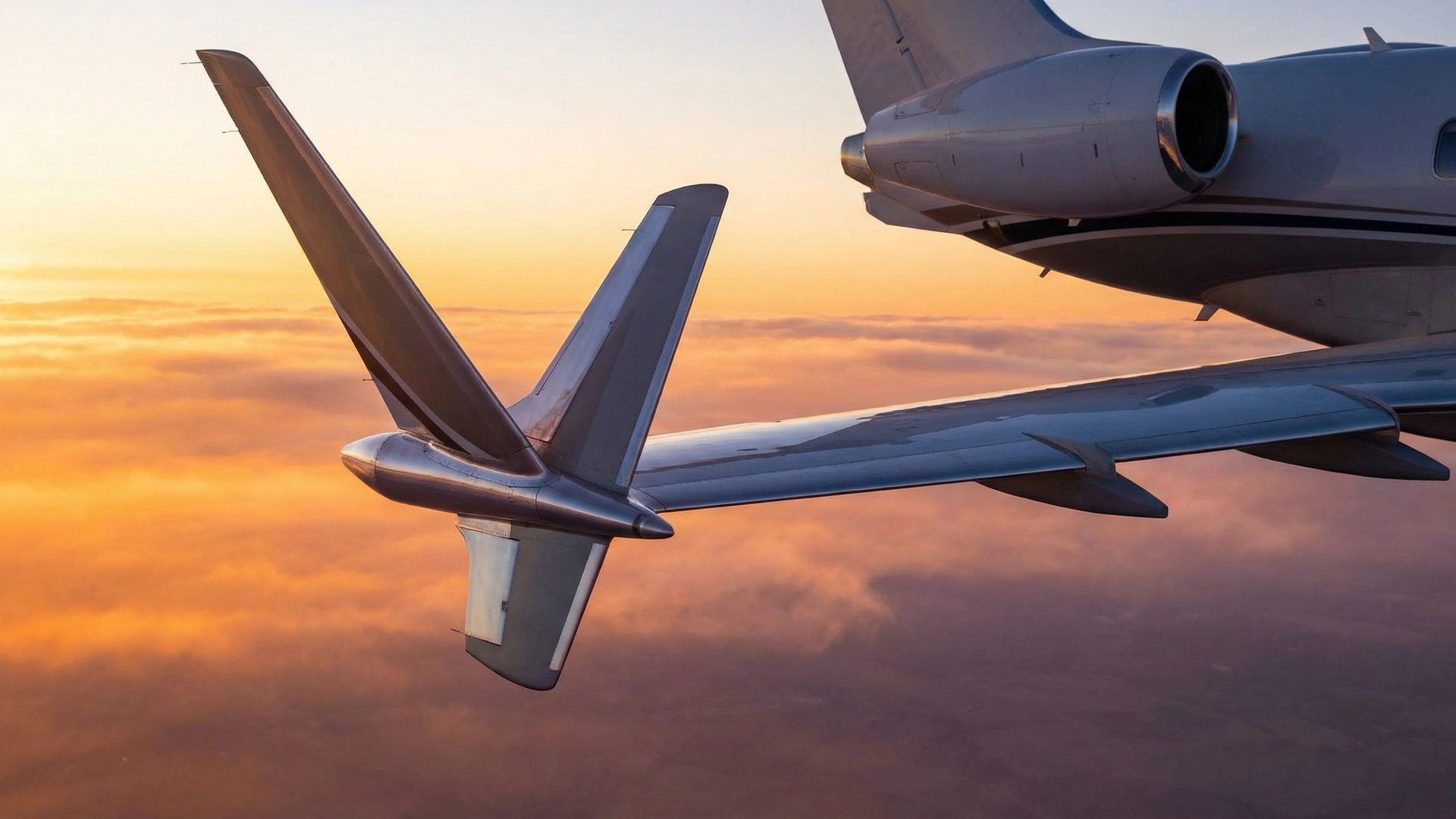
You’ve seen them on every modern private jet. Those angled extensions at the wingtips, sometimes pointing up, sometimes split in both directions, always catching the light at an interesting angle. They look purposeful, aerodynamic, maybe even a bit stylish. But what most passengers don’t realize is that those small structures can add 300 to 500 nautical miles to an aircraft’s range. For a Gulfstream G650 or Bombardier Global 7500 on a transatlantic crossing, that’s the difference between a fuel stop and a direct flight.
The Problem Winglets Solve
Every aircraft wing generates lift by creating a pressure difference. Higher pressure below the wing, lower pressure above it. That’s what keeps you airborne. But at the wingtip, something wasteful happens. High-pressure air from below curls up and around the tip, trying to equalize with the low-pressure air above. This creates a spinning vortex of turbulent air trailing behind the wing.
These wingtip vortices represent pure drag. Energy you’re paying for in fuel burn that does nothing to move the aircraft forward. The bigger and heavier the aircraft, the stronger these vortices become. That’s why you’ll sometimes see airport signs warning smaller aircraft to wait before departing after a heavy jet. Those vortices can flip a light aircraft on its back.
Winglets disrupt this energy loss. By extending the effective wingspan and redirecting the airflow, they reduce the strength of wingtip vortices. Less vortex means less induced drag. Less drag means better fuel efficiency and longer range.
Not All Winglets Are Created Equal
The first generation of winglets appeared on commercial aircraft in the 1970s. Simple vertical extensions, basically small fences at the wingtip. They worked, but engineers kept refining the concept.
Blended Winglets
The blended winglet design smooths the transition from wing to tip extension. Instead of a sharp angle, the winglet curves gradually upward. This reduces interference drag and improves the winglet’s effectiveness. You’ll see blended winglets on most Embraer Praetor series jets and many Citation models. The smooth curve isn’t just aesthetic. It’s measurably more efficient than the old vertical fence design.
Split-Scimitar Winglets
Take a blended winglet and add a second element pointing downward. That’s the split-scimitar design. The upper and lower surfaces work together to manage airflow from multiple directions. Boeing Business Jets popularized this configuration, which can deliver 2% better fuel economy compared to conventional blended winglets. That might not sound like much, but on a 10-hour flight burning thousands of gallons, it adds up quickly.
Raked Wingtips
Some manufacturers skip the vertical extension entirely. Instead, they sweep the wingtip backward and upward in one continuous motion. The Gulfstream G650ER uses this approach. The raked tip still disrupts vortex formation but with less structural weight than traditional winglets. For an aircraft chasing ultra-long-range performance, every pound matters.
The Economics of Efficiency
Real numbers tell the story better than theory. A 400 to 600-pound winglet retrofit on a legacy aircraft can reduce fuel consumption by 4 to 6% over the aircraft’s mission profile. For an operator flying 400 hours annually, that translates to roughly $200,000 in fuel savings per year at 2026 pricing.
But the range extension matters more to most private operators. A Cessna Citation X+ with standard wingtips has a published range of 3,460 nautical miles. That gets you from New York to London with reserves. Add blended winglets, and you pick up an additional 175 nautical miles of capability. Now you can consider routes with strong headwinds or diversions that would have required a fuel stop before.
The math gets more compelling on larger aircraft. A Bombardier Global 6000 retrofit with advanced winglets gains 450 nautical miles of range. That’s enough to open up entirely new city pairs without refueling.
Why Private Aviation Adopted Winglets Faster
Commercial airlines were actually slower to embrace winglet technology. The economics of airline operations favored frequency over range. More flights per day mattered more than fuel savings on individual sectors.
Private aviation runs different math. When you’re operating a $60 million aircraft for a single client or small group, maximizing range and minimizing fuel stops becomes paramount. Nobody wants to add two hours to a transatlantic flight for refueling. The client experience drives the decision.
Sustainability concerns have accelerated adoption recently. Fractional operators like NetJets and Flexjet face increasing pressure to reduce their carbon footprint. Winglets offer a straightforward path to cutting emissions by 5 to 7% without changing flight operations or requiring new aircraft.
What Comes Next
The latest development in wingtip technology moves beyond simple extensions. Active winglets can adjust their angle during flight, optimizing performance for different phases of the mission. Takeoff requires different aerodynamics than cruise. Why not adapt the winglet angle to match?
A few experimental aircraft have tested the concept. The complexity and weight penalty have kept it from production jets so far. But as flight control systems become more sophisticated and materials get lighter, active winglets might finally make economic sense.
For now, those fixed wingtip extensions remain one of the most cost-effective modifications in aviation. A relatively simple structure that delivers measurable improvements in range, fuel economy, and emissions. Sometimes the most visible innovations are also the most practical.